Scotland makes period products free while prices surge in Turkey
Güncelleme tarihi: 1 Nis
In Scotland, menstrual products such as sanitary pads and tampons are now available free of charge. In Turkey, however, the cost of the same products has risen sharply over the past decade.
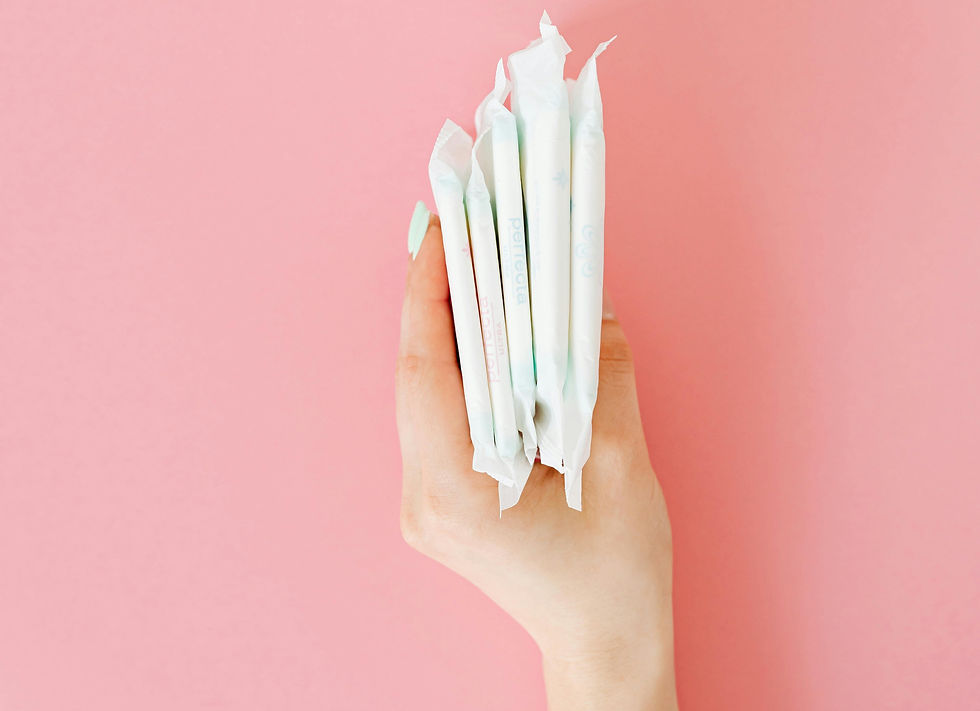
The menstrual cycle — more commonly known as menstruation or a period — is a biological process fundamental to human reproduction. Yet in many societies it remains surrounded by stigma.
In Turkey, menstrual products are still often discreetly placed in black bags at the checkout counter. In Scotland, however, lawmakers have taken a step widely seen as emblematic of a more progressive approach: making period products free for everyone.
The move marks a global first.
So how will it work?
The Scottish government spent five years developing what it calls the“free menstrual products” initiative, a policy designed not only to guarantee access to sanitary pads and tampons but also to confront the broader issue of “period poverty”.
Launched in 2017, the programme had two main goals. The first was grounded in a simple premise: access to menstrual products should be treated as a basic right. The second was to address the wider challenges faced by people who cannot obtain not only pads or tampons, but also the essential conditions needed to manage menstruation safely — such as clean water, accessible toilets and waste disposal facilities.
A 2017 survey conducted by the Edinburgh-based civil society organisation”Women for Independence”, which questioned more than 1,000 women across Scotland, found that one in five had been unable to afford menstrual products due to financial difficulties.

Without access to proper hygiene products, many resorted to makeshift alternatives — including toilet paper, pieces of fabric, old clothes, T-shirts, socks or even newspaper. Health experts warn that such substitutes can pose serious risks to personal hygiene and wellbeing.
From pilot project to national law
The policy did not emerge overnight.
Scotland’s approach began with a pilot programme launched in the eastern city of Aberdeen, where authorities tested ways to improve access to menstrual products.
The initiative was managed by the community organisation Community Food Initiatives North East, and operated through two main channels: civil society groups working with low-income families, and educational institutions including universities and secondary schools.
Researchers found that period poverty within these groups was driven by a range of factors beyond financial hardship. Many participants said they felt embarrassed about buying menstrual products, while others reported limited availability in their neighbourhoods or restrictive family environments — including households where parents were highly controlling or prone to violence.
Surveys conducted in educational institutions revealed further barriers. About one-third of university students and one-fifth of school students reported difficulties accessing menstrual products. Some also said they had missed classes on days when they were unable to obtain hygiene supplies.
A landmark law
Following the pilot phase and several years of expanding access, the Scottish government moved to formalise the policy.
Since 2017, authorities had already spent around £27 million ensuring menstrual products were available in public spaces.
The legislation was formally adopted on 14 August 2022 and came into force the following day, making Scotland the first country in the world to guarantee free menstrual products as a legal right.
Finding products through an app
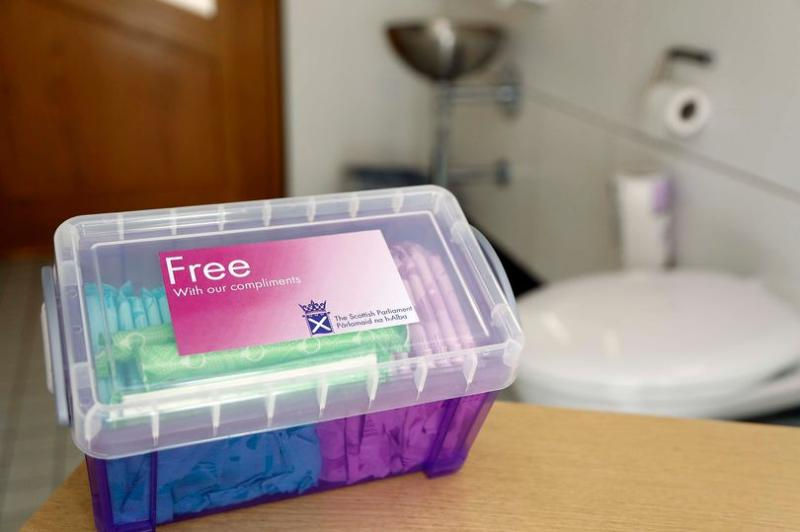
Under the law, local councils must work with community partners to establish more than 1,000 distribution points where menstrual products can be collected free of charge.
These locations include libraries, swimming pools, gyms, public buildings, pharmacies and medical clinics.
To make the system easier to navigate, developers created the PickupMyPeriod app, which allows users to locate nearby distribution points and check which products are available. In some areas, menstrual products can also be delivered directly to people’s homes.

A global challenge
The scale of period poverty extends far beyond Scotland. Across the world, millions of women and girls face similar barriers when it comes to accessing menstrual products and safe sanitation.
According to Celia Hodson, chief executive of the Scotland-based initiative My Period, the problem is widespread even in high-income countries. Hodson, whose organisation developed the PickupMyPeriod application used to locate free menstrual products in Scotland, says one in four women in Scotland experiences period poverty at some point in her life.
“We hear about many mothers who go without protection during their periods just to feed their children,” Hodson said. “Some end up using socks or newspaper stuffed inside bread because it is cheaper than menstrual products.”
Hundreds of millions affected
Globally, the numbers are far more stark.
Data from the World Bank suggests that at least 500 million women and girls worldwide lack access to the products or facilities needed to manage their periods safely.
Access to water and sanitation remains a major obstacle. Research by the UNICEF found that in 50 low-income countries only 51 percent of schools have adequate water supplies, while just 45 percent have proper toilets and sanitation systems.
A 2014 report by UNESCO paints an equally troubling picture in sub-Saharan Africa, where one in ten girls lacks access to menstrual products or a clean, safe toilet. As a result, many are forced to miss school during their periods, reinforcing cycles of inequality in education and health.

“Menstrual huts”: a persistent stigma
In some parts of the world, menstruation is still treated not only as a taboo but as a cause for social exclusion.
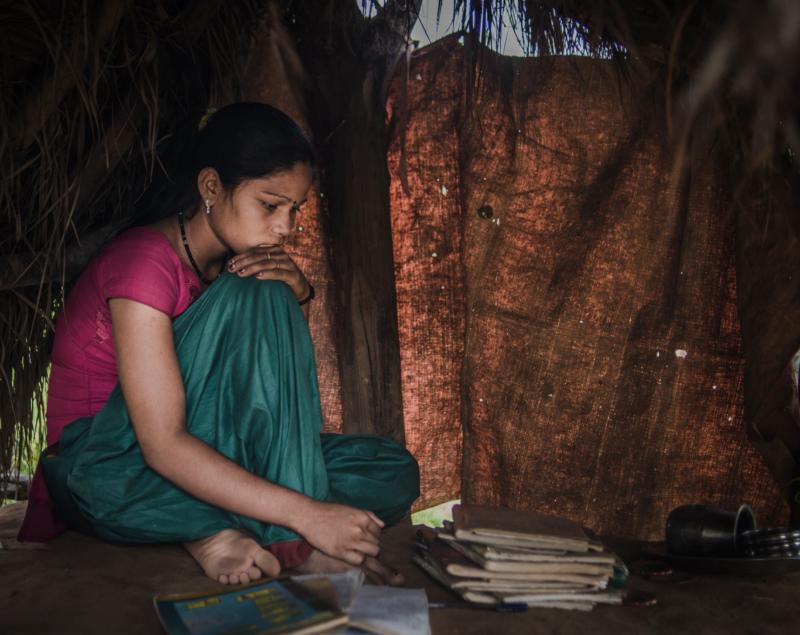
In Nepal — India’s northern neighbour — a deeply controversial practice known as Chhaupadi forces menstruating women and girls to stay in small huts or isolated shelters during their periods because they are considered “impure.”
Although the practice was formally banned in 2005, it has proven difficult to eradicate.
A report published in 2019 by the National Human Rights Commission of Nepal found that at least 18 women and girls had died since 2005 while living in so-called menstrual huts. Deaths have been linked to exposure to cold, snake bites, smoke inhalation and other hazards associated with the isolated structures.
Choosing between hygiene and food
Even in wealthier countries, period poverty can force difficult choices.
A study conducted in France among 6,500 women found that one in three sometimes prioritised essential expenses such as food over purchasing menstrual hygiene products — highlighting how financial pressures can shape basic health decisions even in developed economies.
How other countries are addressing period poverty
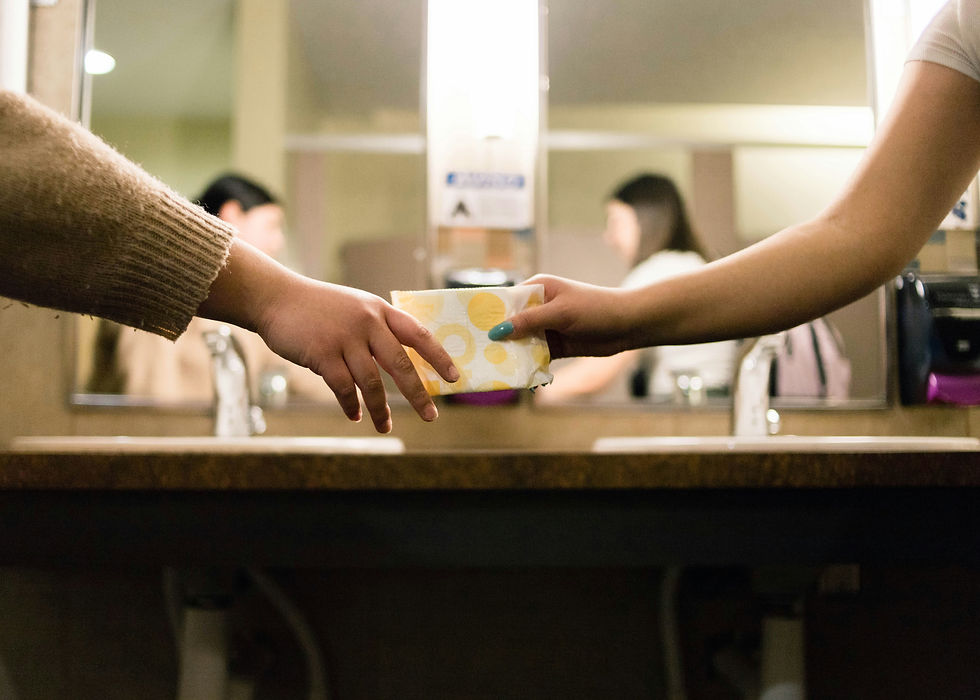
While Scotland has become the first country to legally guarantee universal free access to menstrual products, similar initiatives have emerged around the world in recent years.
One of the most notable examples is New Zealand. In early 2020, then–prime minister Jacinda Ardern announced a nationwide programme to provide free menstrual products in schools.
“We know that nearly 95,000 girls aged 9 to 18 are missing school because they cannot afford these products,” Ardern said at the time, adding that making them freely available would help improve attendance and educational equality.
Backed by an investment of about $2.6 million, the programme began distributing pads and similar hygiene products free of charge in schools across the country from June 2021.
Neighbouring Australia had already introduced a similar measure in 2018, announcing that pads and tampons would be provided free of charge in all public schools.
In the United States, New York City launched a programme in 2016 to supply free menstrual products in schools. By 2018, the initiative expanded across New York.
At the time, the state’s governor Andrew Cuomo defended the policy in a social media statement, saying that menstrual products are “as necessary as toilet paper and soap.”
Other states soon followed. By mid-2021, Virginia, Washington and Illinois had adopted similar measures in schools.
Tax reforms and education programmes
In Africa, several countries have taken a different route by removing taxes on menstrual products.
Kenya became the first country to abolish taxes on sanitary products in 2004, later eliminating import duties in 2011. The government now spends roughly $3 million annually providing free pads to schools in low-income areas, a programme expanded nationwide in 2018.
Data from the Kenyan civil society organisation ZanaAfrica suggests that about one million girls in the country miss school because they cannot access menstrual hygiene products.
Elsewhere on the continent, Zambia began introducing menstrual hygiene education programmes in schools in 2019, two years after announcing plans to distribute free sanitary pads in poorer regions.
In Botswana, a government campaign launched in 2015 to promote women’s dignity led to free menstrual products being provided to school-age girls from 2017 onwards.
A growing number of countries have also eliminated taxes on menstrual products altogether, including Rwanda, Namibia, South Africa, Colombia, Malaysia, Lebanon, Tanzania, Nigeria, Nicaragua, Jamaica, India, Australia, Kenya and Canada.
In Canada, several provinces — including British Columbia, Ontario, Nova Scotia and Prince Edward Island — distribute free menstrual products in schools. France introduced free menstrual products in all universities in February 2021.

Which countries offer menstrual leave?
For many people who menstruate, periods can come with a range of physical symptoms — including headaches, abdominal cramps and lower back pain. The most common cause of menstrual pain is the contraction of the uterus, a muscular organ whose walls tighten as levels of prostaglandin hormones increase.
In some cases, the pain can be severe enough to disrupt daily life, prompting a number of countries to introduce menstrual leave policies for employees.
One of the earliest adopters was the Soviet Union, which introduced the world’s first legal menstrual leave policy in 1922.
Today, South Korea is among the countries where the practice remains enshrined in law. The country first introduced menstrual leave in 1953, and legislation approved in 2001 allows female employees to request one unpaid day of leave per month during their period.
In Japan, menstrual leave was introduced shortly after the World War II. Under the Labour Standards Act of 1947, workers experiencing painful periods or working in conditions that might worsen menstrual symptoms are entitled to what is known as “physiological leave.”
Although Japan and South Korea pioneered these policies, the number of employees actually using them has declined over time — partly due to long working hours and workplace culture.
A 1965 study found that about 26 percent of working women in Japan used menstrual leave. By 2017, a government survey suggested that figure had dropped to just 0.9 percent.
In South Korea, usage has also decreased, falling from 23.6 percent in 2013 to 19.7 percent in 2017.
More recently, Spain has taken one of the most significant steps on menstrual leave in Europe. In May 2022, the Spanish cabinet approved legislation granting three to five days of medically approved menstrual leave for workers experiencing severe symptoms.
The law officially came into force in 2023, marking a landmark policy in Europe’s labour and public health landscape.
Menstrual leave and policy debates in Turkey
In Turkey, menstrual leave once existed in a limited form but was later removed from legislation.
The right was first introduced in 2004 for women working in “heavy and hazardous jobs,” allowing up to five days of leave. However, the provision — included in the country’s Heavy and Hazardous Work Regulation — was never widely implemented in practice.
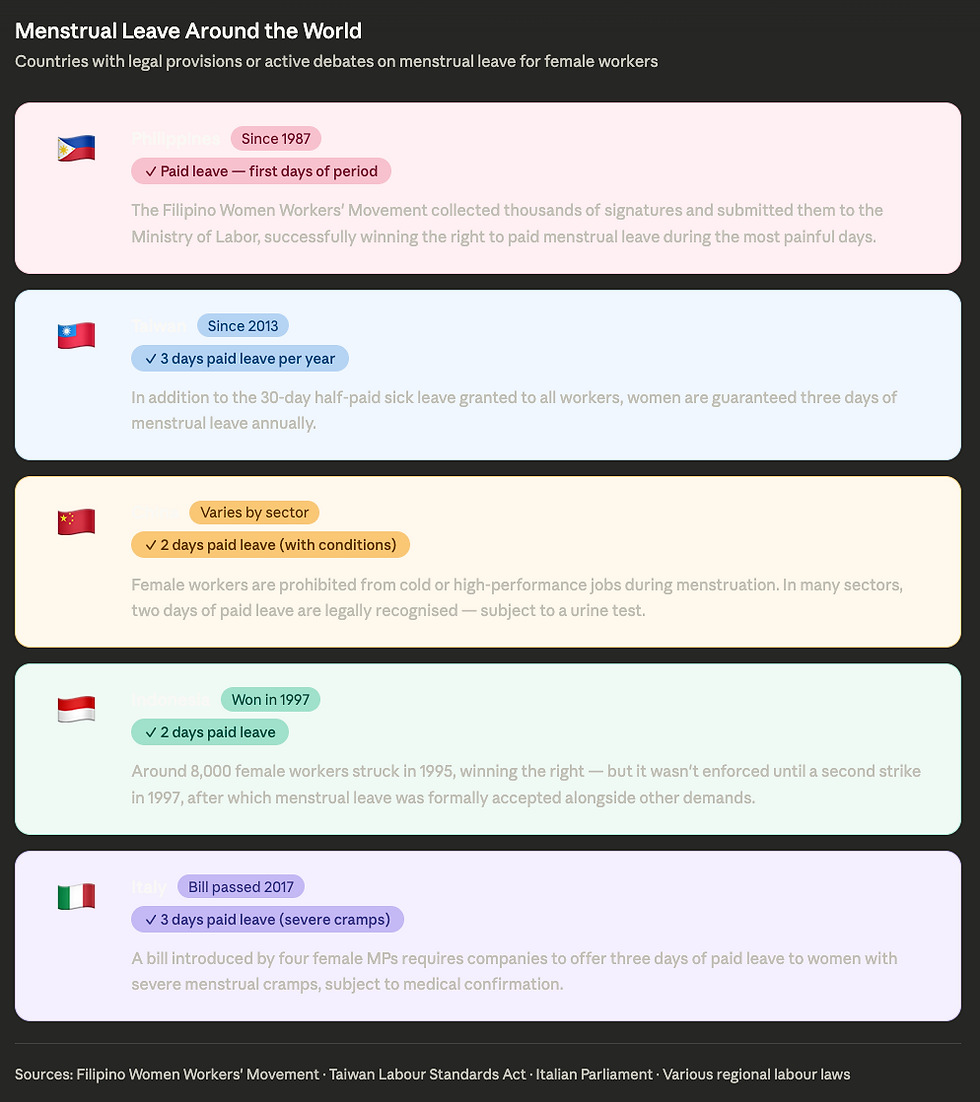
When the regulation itself was abolished in 2013, the legal basis for menstrual leave effectively disappeared.
Today, menstrual leave exists only through isolated initiatives by individual institutions and employers. Among those that have introduced their own policies are the İzmir Bar Association, Kadıköy Municipality, Tunceli Municipality, Bornova Municipality, Tire Municipality, the food delivery company Zomato, and the independent news outlet Bianet.
Legislative proposals in parliament
The issue of access to menstrual products has also been raised several times in the Turkish parliament by female lawmakers.
In 2019, Sera Kadıgil, then an MP for Republican People's Party representing Istanbul and now spokesperson for the Workers' Party of Turkey, submitted a bill proposing a reduction in taxes on menstrual hygiene products. Kadıgil argued that the value-added tax on such products was higher than that applied to certain drugs marketed for sexual performance.
Another proposal came in December 2021 from Meral Danış Beştaş, deputy parliamentary group leader of the Peoples' Democratic Party, who introduced a draft bill that would have made International Women’s Day a public holiday, ensured free access to menstrual products and granted one day of menstrual leave.
In early 2022, Candan Yüceer, a member of parliament from Tekirdağ for the Republican People's Party, proposed cutting the tax rate on menstrual products from 18 percent to just 1 percent.
Tax reduction — but criticism remains
The most significant legislative change came in March 2022, when the Turkish government reduced the value-added tax (VAT) on menstrual products from 18 percent to 8 percent.
Advocacy groups welcomed the move but argued it would not eliminate period poverty.
The civil society organisation Konuşmamız Gerek (We Need to Talk) Association, founded in 2017 to combat menstrual poverty and stigma in Turkey, described the tax cut as a “step forward” but warned that broader structural issues remained.
Speaking to Independent Türkçe, the group’s co-founder İlayda Eskitaşcıoğlu said the reduction had not significantly improved affordability or access for many people who menstruate.

“We would prefer to see the tax removed entirely,” Eskitaşcıoğlu said. “But menstrual poverty is not only about access to products. It is also about changing gender norms and transforming how menstruation is perceived in society.”
She also pointed to the language used in the official regulation published in the Official Gazette of Turkey on March 29, 2022. Instead of explicitly referring to sanitary pads or tampons, the document described them only as goods listed under “position 9619.00 of the Turkish Customs Tariff Schedule.”
According to Eskitaşcıoğlu, this wording reflects the persistence of cultural taboos.
“It was as if naming these products openly in a public document would be shameful,” she said.
“While other items are listed by name, menstrual products appear only as a customs code. For us, this shows that menstruation still struggles to be openly acknowledged.”
Activists say debate should continue
Advocates in Turkey warn that reducing the tax on menstrual products should not signal the end of the discussion.
According to İlayda Eskitaşcıoğlu, co-founder of the civil society organisation Konuşmamız Gerek Association, there is a growing perception that the issue has already been resolved after the value-added tax (VAT) rate was lowered.
“There is an expectation that the issue will be removed from the public agenda now that the VAT has been reduced,” she said.
Eskitaşcıoğlu also noted that the topic has largely been raised in parliament by female lawmakers, something she says reflects the broader lack of political attention to menstrual health.
“The fact that only women MPs are bringing this issue forward already says a lot,” she said, adding that once the VAT rate was reduced to 8 percent, many other legislative proposals were effectively shelved.

Still, she argues, feminist organisations continue to push for broader reforms.
“These groups are pressing for further tax reductions and for menstrual products to be made freely accessible in public institutions — particularly in state schools, prisons and university dormitories,” she said.
Turkey’s first study on period poverty
The Konuşmamız Gerek Association, founded under the leadership of Eskitaşcıoğlu and sociologist Bahar Aldanmaz Fidan, also conducted Turkey’s first comprehensive study on period poverty.
One of the report’s key findings is that the concept is often misunderstood. Period poverty is frequently interpreted only as the inability to purchase menstrual products due to financial hardship.
But the organisation argues the issue is far broader.
In its report, the group defines period poverty as a situation where individuals who menstruate may also struggle to access clean water, soap, waste bins, safe toilets, toilet paper and healthcare services — all of which are essential for managing menstruation safely and with dignity.
The research also highlights patterns in menstrual product use across the country. Due to socio-cultural factors, generational habits and accessibility, sanitary pads remain the most widely used menstrual product in Turkey.
At the same time, alternative options — including tampons, menstrual cups, reusable pads and period underwear — are gradually becoming more common as awareness grows and product availability expands.
Access to menstrual hygiene and sanitation in Turkey
The survey conducted by Konuşmamız Gerek Association included 4,108 participants aged 18–53 from all 81 provinces of Turkey, who either menstruate or were unsure if they do.
Most respondents reported having access to soap, clean water, waste bins, toilet paper, and safe toilets or healthcare facilities. However, a significant minority faced challenges.
* 21.1% could not always access soap
* 16.3% could not always access clean water
* 31.8% could not always access waste bins
This means roughly one in five participants lacked consistent access to soap and clean water, which are essential for menstrual hygiene. Additionally, 29.8% said they rarely or never had access to a toilet where they felt safe.

Toilet paper is the second most used product
Sanitary pads are the most widely used product, at 90.9%.
In the Black Sea region, the second most common product after pads is toilet paper, whereas in the other six regions, tampons are more commonly used as a secondary product.
Tampon use is highest in the Marmara Region (23%) and lowest in the Black Sea Region (9.4%).
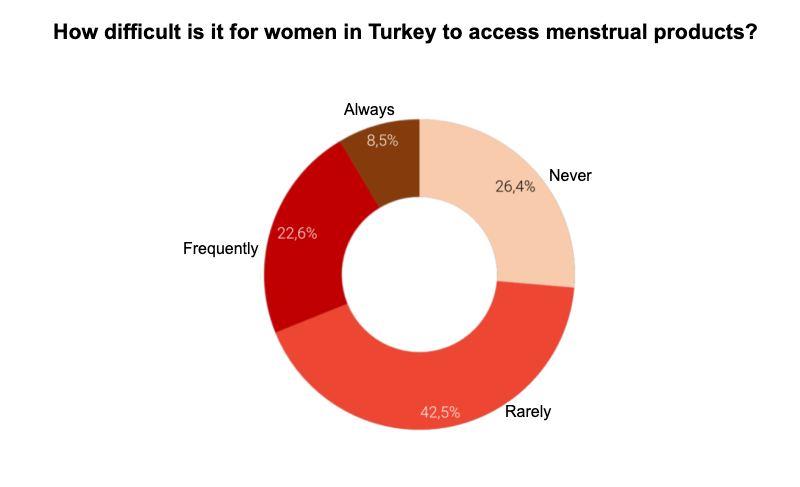
* 26.4% of participants never experience difficulty purchasing menstrual products.
* 42.5% experience difficulties rarely,
* 22.6% experience difficulties often,
* 8.5% experience difficulties always.
Income and menstrual product access
The study shows that difficulties in accessing menstrual products are not strictly linked to income.
Among participants with 0 TL monthly income, 16.3% reported rarely facing difficulties. Among participants with over 15,000 TL monthly income, 22.4% reported rarely facing difficulties.
While toilet paper usage is more common among lower-income groups, in almost all income levels it follows sanitary pads and tampons as the next most used product.
This research highlights that period poverty in Turkey involves both economic and infrastructural challenges, affecting access to essential hygiene products and safe facilities across all income levels.
Prices soar as pain and taboo persist
Over the past decade, the cost of menstrual products in Turkey has skyrocketed, highlighting a growing public health and gender equality concern.
According to the data from the Turkish Statistical Institute (TÜİK), the price of a single sanitary pad has surged by 330% between 2012 and 2022.
In April 2012, a pad cost just 0,30 lira; by 2022, prices ranged from 15 to 50 lira, and by 2026, some products sell for 70 to 450 lira.
Some products contain toxic chemicals
“It’s not just about prices. Some menstrual products contain toxic chemicals, and many have extremely high plastic content,” said young lawyer İlayda Eskitaşcıoğlu,“From a consumer rights perspective, the process is opaque—there’s very little transparency.”
Eskitaşcıoğlu stressed that Turkey could learn from Scotland’s initiative providing free menstrual products, but several foundational steps are necessary first.
“Period poverty and menstrual taboos are intertwined. Comprehensive sex education must be included in the national curriculum,” she said.
“Currently, a child experiencing their first period has no guidance at home or in school about which products to use, or why menstruation is natural and nothing to be ashamed of. These issues must be addressed alongside product access.”
The denial of menstrual pain
The problem extends beyond access and cost.
In its research, Konuşmamız Gerek incorporated open-ended questions alongside a national survey to capture women’s experiences with menstruation.
Among the 588 respondents who provided detailed responses, 23.1% reported experiencing severe menstrual pain.
The report underscores a persistent social disbelief around menstrual pain.
“Many participants said that when they told healthcare providers or people around them that they were suffering, they were not believed. Others were told they were exaggerating,” the report reads.
“Because their pain was dismissed, they often continued with work and daily tasks despite significant discomfort. Many respondents also expressed a desire for paid menstrual leave.”
Eskitaşcıoğlu emphasizes that addressing menstruation in Turkey requires more than reducing prices. “We need systemic changes—social attitudes, education, and workplace policies—to tackle the stigma and provide real support for those who menstruate.”
“As an ‘unmarried’ person, we fear judgment for using menstrual products,” say Turkish women
In Turkey, menstruation remains shrouded in fear and stigma, according to a recent study by advocacy group Konuşmamız Gerek.
Beyond the familiar issues of access and affordability, the research highlights how fear permeates nearly every aspect of menstrual life.
Participants recounted anxieties ranging from simply being on their period, to being noticed while menstruating, to irregular cycles and menstrual pain. The fear extended to buying menstrual products, worries that irregular periods might affect fertility, judgment for using products as an unmarried person, increased sexual desire during menstruation, and even frequent trips to the bathroom.
“In other words, a natural process like menstruation is experienced with a host of fears in our country,” the study notes.
Ilyada Eskitaşcıoğlu, co-founder of Konuşmamız Gerek, identified two striking patterns from open-ended survey responses. The first is the dismissal of menstrual pain, with many women reporting that their discomfort is often treated as exaggeration. The second revolves around societal preoccupations with “virginity.”
“Many people, especially those using tampons or menstrual cups, associate menstruation with fear and anxiety because they worry others will find out,” Eskitaşcıoğlu explained.
Unrealistic TV commercials
The study also calls out misleading advertising from menstrual product companies.
Since the early 2000s, marketing campaigns have portrayed menstruation as empowering, often using images of active, carefree women. Blood in ads is frequently represented by blue liquid, echoing baby diaper commercials.
“We do not try to depict menstruation as an idealized, flawless experience—like everyone playing beach volleyball in shorts feeling fantastic,” Eskitaşcıoğlu said. “We aim to portray it as it truly is.”
Looking ahead, Konuşmamız Gerek plans to make the Menstrual Poverty Research an annual project, tracking trends and developments across Turkey over time.
“Our goal is to provide this ongoing data to public institutions, menstrual product brands, and other stakeholders,” Eskitaşcıoğlu said, emphasizing the need for both visibility and policy attention around menstruation in the country.
(This article was first published in Independent Turkish on July 20, 2022)


Yorumlar