The next mining frontier may lie beyond Earth
As the world races to secure dwindling natural resources, a new industry is looking far beyond the planet—toward asteroids rich in water and precious metals.

(This article received the Golden Pen Award from the Turkish Economy Reporters Association in 2017)
Humanity’s search for resources may soon extend beyond Earth.
According to a July 2016 report by the United Nations, global consumption of natural resources has tripled over the past four decades. The environmental organization World Wide Fund for Nature (WWF) warns that the current level of consumption would require the equivalent of 1.6 Earths to sustain.
Data compiled by the UN shows that the amount of minerals extracted from beneath the Earth’s surface rose from 22 billion tonnes in 1970 to 70 billion tonnes by 2010.
By 2050, humanity could require as much as 180 billion tonnes of minerals each year to meet global demand.
While governments search for solutions in renewable energy and sustainable development, some companies have already begun looking for answers far beyond the planet.
One of them is Planetary Resources, a space technology company backed by investors including Richard Branson, founder of Virgin Group; Larry Page, one of the founders of Google; and Eric E. Schmidt former CEO of Google.
Founded in 2011, the company has been analysing the composition and thermal properties of Earth’s mineral resources while simultaneously researching how those same materials might be extracted in space.
Its long-term vision: mining asteroids not only for metals such as iron and nickel, but also for platinum and even water, both of which could transform future space exploration.
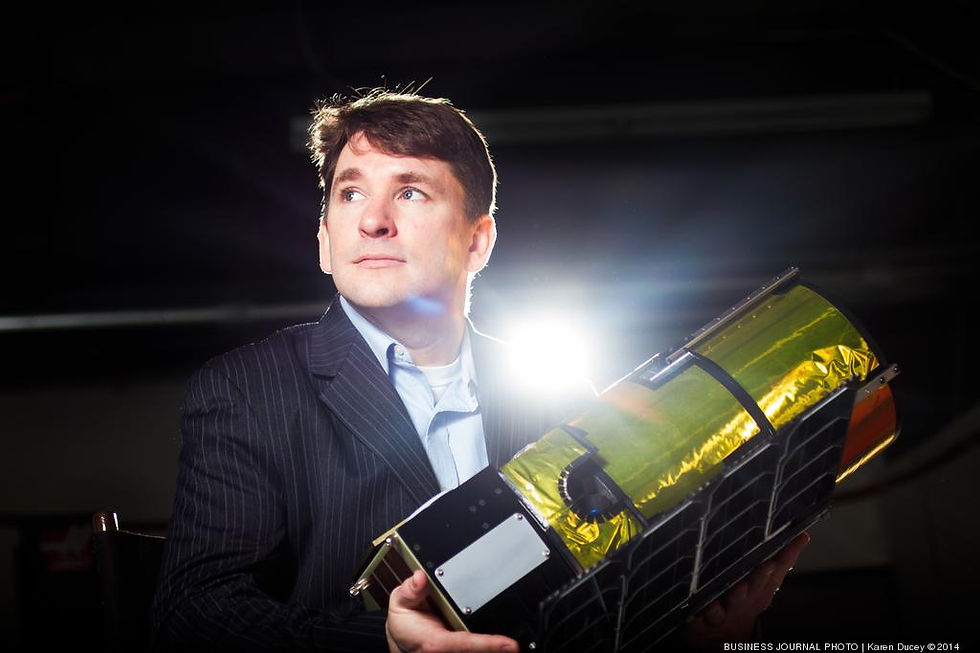
“The traditional mining and energy industries we know on Earth will eventually move into space,” said Chris Lewicki, chief executive of Planetary Resources.
A short history of asteroid exploration
Over the past two decades, scientists have gathered an unprecedented amount of information about asteroids, Lewicki said. Spacecraft have been sent to study them, their surfaces analysed, and in some cases samples have even been returned to Earth.
Particular attention has been given to near-Earth asteroids, the celestial bodies that pass relatively close to the planet. Lewicki estimates that roughly 60 million asteroids exist, yet only about 1% have been identified, and around 15,000 of those pass near Earth.
“There are thousands of asteroids that are easier to reach than landing on the Moon,” he said. “Many of them have been known to science since before the Moon landings half a century ago.”
If the right asteroid can be identified, the resources extracted there could help support entirely new industries in space—from orbital construction to even future tourism on Mars.
The first steps toward space mining
Planetary Resources took a major step toward that vision on 16 July 2015, when its experimental satellite Arkyd 3 Reflight (A3R) was deployed to the International Space Station to test key technologies.

The next phase of the project involves a network of small satellites known as Ceres. Planned as a fleet of around 10 micro-satellites, each weighing between 10 and 100 kilograms, the system would observe agricultural regions, monitor oil and gas infrastructure, and analyse Earth’s mineral resources—while also scanning asteroids for potential mining targets.
Unlike conventional satellites that capture images visible to the human eye, the Ceres system would rely on infrared sensors capable of examining the Earth’s surface layer by layer.
Farmers could one day use the data to monitor individual hectares of land in minute detail on tablet screens, adjusting their crops accordingly. The same technology could also detect harmful bacteria or large forest fires long before they spread.
When will the first asteroid be mined?
Asked when the first asteroid resources might be extracted, Lewicki does not point to some distant future generation.
Instead, he says the first prospecting missions could begin as early as 2020, and that asteroid mining could become routine within 10 to 15 years.
Bringing those resources back to Earth, however, is another matter. The main obstacle is the enormous cost of transporting material through space.
The biggest challenge: fuel
To explain the challenge, Planetary Resources often uses a simple analogy.
Imagine driving across the United States—from the far west to the far east—without a single gas station along the way, while carrying every drop of fuel you will need for the journey. In space, the problem is even greater.
A spacecraft launching from Earth consumes around 50 kilograms of fuel to travel the first 300 kilometres. After that stage, reaching 35,000 kilometres requires only about 4 kilograms, while two kilograms of fuel can propel a craft toward Mars or nearby asteroids.

The reason the first few hundred kilometres are so demanding is simple: escaping Earth’s gravity.
Even routine satellite launches illustrate the scale of the cost. Roughly 400 communication satellites orbit the planet, supporting services ranging from GPS navigation to satellite television and internet communications.
According to Lewicki, operating each of those satellites requires fuel and maintenance that can cost around $50 million per year, creating a market worth roughly $20 billion annually.
A spacecraft powered by water
For Planetary Resources, solving the fuel problem is therefore more urgent than bringing precious metals back to Earth.
Rather than hauling everything from the planet, the company hopes to use resources already available in space, and come back to Earth with less material. The strategy is to locate the right asteroids, extract materials there, and convert them into fuel—potentially creating the first space-based refuelling stations.
Surprisingly, the most valuable resource may not be rare metals but water. Hydrogen, one of water’s components, is a key ingredient in rocket fuel.
Water could also protect astronauts from radiation. Lewicki says that one cubic metre of water can block nearly all radiation in space, much like nuclear waste on Earth is stored in water-filled pools for shielding.
Finding water on asteroids could therefore unlock access to other minerals as well. But transporting it back to Earth is not a near-term goal: moving just 1,000 litres of water in space can cost millions of dollars.
Platinum in space
After water, another priority for Planetary Resources is platinum, one of the rarest metals on Earth.

Even in the richest terrestrial mines, producing one gram of platinum requires processing around a tonne of ore, Lewicki said. Asteroids, by contrast, may contain platinum deposits up to 100,000 times more concentrated than those found on Earth.
If technology eventually allows large quantities to be transported back to the planet, such resources could have significant applications—including in cancer treatment technologies.
Other elements that could be mined from asteroids include rare metals such as neodymium, radium and osmium, materials used in advanced magnets and industrial applications.
Lewicki has even shared small carbon samples obtained from a comet, composed largely of water and ice, which could potentially be used as building materials for future space infrastructure.
Who owns space resources?
One of the most unresolved questions surrounding asteroid mining is ownership.
Under international agreements established in the late 1960s, no country can claim sovereignty over territory in space. However, materials collected in space can be owned.
In practical terms, that means nations backing Planetary Resources—including the United States, the United Arab Emirates and Luxembourg—could claim rights to resources brought back to Earth.
Lewicki compares it to fishing in international waters: the ocean itself belongs to no one, but the fish belong to whoever catches them.
The company recently secured €25 million in funding from the Luxembourg government, along with $21.1 million in private investment from backers including Larry Page, the Russian robotics firm Grishin Robotics and venture capital group Vast Ventures.
Despite the perception that such ventures are limited to technologically advanced nations, Lewicki believes the potential of space extends far beyond that.
“Human thinking needs to move beyond purely earthly concerns,” he said.
“We must understand that space is not only a scientific endeavour—it is a new economy, and even a new geography.” 🚀
(This article was first published in BusinessHT on December 23, 2016. However, the original article is no longer online due to the website being shut down.)


Yorumlar