Billions in donations, decades of earthquake taxes — So why are survivors still paying for their new homes?
From the British Royal Family to the United Nations, the world sent money to Turkey after the February 2023 earthquakes. For decades before that, Turkey collected a dedicated earthquake levy from its citizens. Three years on, more than 360,000 people remain in temporary housing — and those who have received new homes are paying for them in instalments. We investigate why.

Walk down any street in the earthquake zone today and life pushes back at you: a school bell ringing, a shopkeeper rolling up a shutter, someone running for a bus. But turn a corner and the ruins are still there — or the construction site where ruins used to be, raw concrete rising where an entire neighbourhood once stood.
Three years after the deadliest earthquake in Turkey's modern history, the cities of the south-east are rebuilding. The question of who is paying for that rebuilding — and why survivors are expected to pay at all — remains unresolved, and, for many of those affected, painfully live.
The February 2023 earthquakes struck eleven provinces, killed more than 53,000 people and displaced 3.3 million, according to a United Nations Development Programme report published six weeks after the disaster. More than two million were placed in tent camps and container settlements. Three years on, the container cities have thinned — but according to the Strategy and Budget Directorate's January 2026 report on reconstruction and recovery, 360,455 people across cities and villages are still living in temporary accommodation.
For those who lost their homes, the challenge has become a different kind: debt.
Survivors who owned homes that were destroyed have been made eligible for new state-built housing — but on credit, not as a gift. Turkey had already been in a deepening economic crisis since 2018. The earthquake added a housing loan to the burden.
The question that followed — as it follows every major Turkish earthquake — was simple and, for many survivors, infuriating: given everything that was donated from abroad & locally and collected in earthquake taxes at home, why are the houses not free?

First answer: The law says so
The legal foundation for how Turkey handles post-disaster housing has been in place since 1959. Law No. 7269, published in the Official Gazette on 25 May of that year and titled "Law on Measures to Be Taken and Aid to Be Provided Due to Disasters Affecting Public Life," includes detailed provisions on how the cost of replacement housing is to be structured and recovered.
Article 27 establishes that the cost of newly constructed buildings — including the value of the land on which they stand — constitutes the "cost" of those buildings. Expenses for mapping, planning, research and technical assistance, and for reconstruction of public roads, water, electricity and sewerage infrastructure, are not charged to survivors. But the remaining balance — after deducting the assessed value of whatever the survivor previously owned — is charged back as a debt.
Article 29 establishes the concept of "rights holder" (hak sahibi): a family living in a building that was destroyed, seriously damaged or located in an area designated for expropriation under a new development plan — provided they can document their ownership or occupancy and meet the eligibility criteria.
And also, Article 40 sets repayment terms: housing loans are interest-free, with a minimum 20-year and maximum 30-year repayment period.
Commercial premises such as shops and bakeries carry 4% annual interest and are repaid over 5 to 15 years. The first two years are payment-free.
Overdue instalments accrue a penalty rate of 5% per year. Survivors who pay off their remaining balance early — in a lump sum of at least two years' instalments — receive a 20% discount.

Who qualifies — and who does not
Eligibility for state-built housing is determined locally by a Rights Holders Commission, chaired by the relevant district governor or a designated representative. The criteria are specific, and the exclusions are significant.
Those who can document ownership or occupancy of a building that was destroyed or seriously damaged, and who meet all of the following conditions:
* Applied within the legally required timeframe
* Do not own — and whose spouse does not own — any other undamaged property elsewhere
* Are the owner of the property, not a tenant
Who does not qualify?
* Tenants
* Foundations and associations (legal entities)
* Owners of buildings constructed illegally or without planning permission in restricted zones
* Those without DASK (Compulsory Earthquake Insurance) — though those with DASK may receive both an insurance payout and state housing, provided they meet the other criteria
* Regardless of how many damaged properties they owned, a rights holder receives only one state-built unit
State housing is delivered through four mechanisms: via TOKİ (Turkey's Housing Development Administration), through open tender, through self-build grants for those who prefer to construct their own homes, and through subsidised market-purchase loans.
For those building their own homes on unregistered land, a guarantor or mortgage on another property is required as security for the loan — a provision that, in the economic context of the earthquake zone, can present a significant barrier.

Second answer: Inflation has made everything impossible
Legal structure aside, economists and construction experts point to a more immediate obstacle: Turkey's persistent and severe inflation, which has hit the construction sector with particular force.
Headline consumer price inflation stood at 55.18 percent in February 2023 — the month of the earthquakes — according to the Turkish Statistical Institute. By February 2026 it had fallen to 31.53 percent, but remained deeply embedded.
Residential property inflation over the preceding twelve months exceeded 42 percent. The construction cost index, tracked between February 2023 and January 2026, rose by 160 percent.
The concern about construction inflation was raised publicly within days of the disaster.
On 25 February 2023, the chairman of the Union of Chambers and Commodity Exchanges of Turkey (TOBB), Rifat Hisarcıklıoğlu, announced that building materials manufacturers had agreed to freeze prices for supplies going to the earthquake zone, provided that their own input and raw material costs did not rise.
It was a significant commitment — and an implicit acknowledgement of how quickly the economics of reconstruction could spiral.
The condominium problem no one has solved
Beyond cost and law, there is a third dimension to the housing question — one that is less visible but, according to experts, deeply consequential.
It concerns the legal status of property ownership itself in Turkey, and a distinction that millions of homeowners do not fully understand until a disaster forces the question.
Professor Ali Hepşen, a faculty member at Istanbul University's Faculty of Business Administration, raised this point in an interview.

He noted that it is not known how many of the destroyed buildings in the earthquake zone held full condominium title (kat mülkiyeti) as opposed to construction-phase easement title (kat irtifakı).
(Editor's note: In Turkish property law, kat irtifakı (construction-phase easement) is issued while a building is still under construction. It represents only the buyer's proportional share of the land plot — not ownership of the actual apartment. Kat mülkiyeti (condominium title) is issued once a building is complete, all regulatory procedures have been fulfilled, and an occupancy permit (iskan) has been granted. Only at this point does the owner legally possess both the apartment and their share of the land. Many Turkish residents live in homes for which this transition has never been completed, meaning they technically own only a fraction of the land beneath a building that may no longer exist.)
"Turkey's biggest problem is the quality of buildings — not only in structural terms, but in regulatory terms. When you buy an apartment in normal circumstances, it should carry full condominium title. You should be buying both the four walls and your share of the land. In Turkey, most buildings have never completed that transition”, Hepşen said.
He illustrated the stakes plainly: "Imagine you live in apartment number three. The building has collapsed. But what you actually paid for may not have been the space you lived in — it may have been only the land share corresponding to that space."
When a building is destroyed, the distinction between kat irtifakı and kat mülkiyeti becomes a legal and financial chasm. The reconstruction process may, inadvertently, force a resolution: new state-built homes, having passed through all required procedures, will carry full condominium title. For many residents, it will be the first time they have genuinely owned what they thought they owned.
"Perhaps through this process," Hepşen said, "the entire inventory will finally be properly recorded."
He compared it to buying a car: "When you buy a car, you receive an invoice that confirms the vehicle has been fully assembled and delivered to you. You are not buying a hypothetical car. With kat irtifakı, you pay the money but you don't know what you're actually getting."
How much do the new homes cost?
Earthquake housing units are being built to standard dimensions: approximately 105–110 square metres gross for three-bedroom units, and 85–90 square metres gross for two-bedroom units.
In a statement on 11 February 2026, President Erdoğan announced that the state is covering 65 percent of the total cost — including infrastructure — of the 455,000 units being delivered.
Survivors will begin instalment payments two years after receiving their homes. The terms, as announced, are as follows:
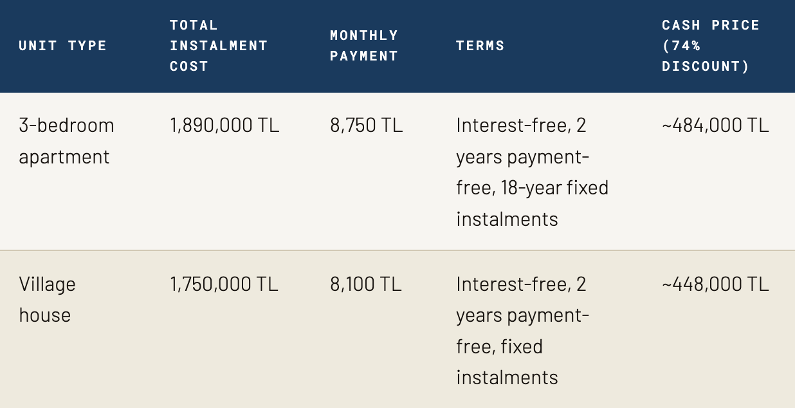
State bank loans are available for those who prefer to pay in full at the outset. The 74 percent cash discount — bringing a three-bedroom apartment to approximately 484,000 lira — represents a significant incentive for those with access to capital, but is inaccessible to most survivors in the earthquake zone.
A promise that was revised, then missed
The scale of the reconstruction commitment was extraordinary.
On 13 April 2023, President Erdoğan promised the construction of 650,000 new housing units and village homes across the earthquake zone, with 319,000 to be delivered within a year, and full urban recovery to follow.
That target was revised downward before the year was out: 319,000 became 200,000. The actual number of homes delivered within one year of the disaster was 46,000.
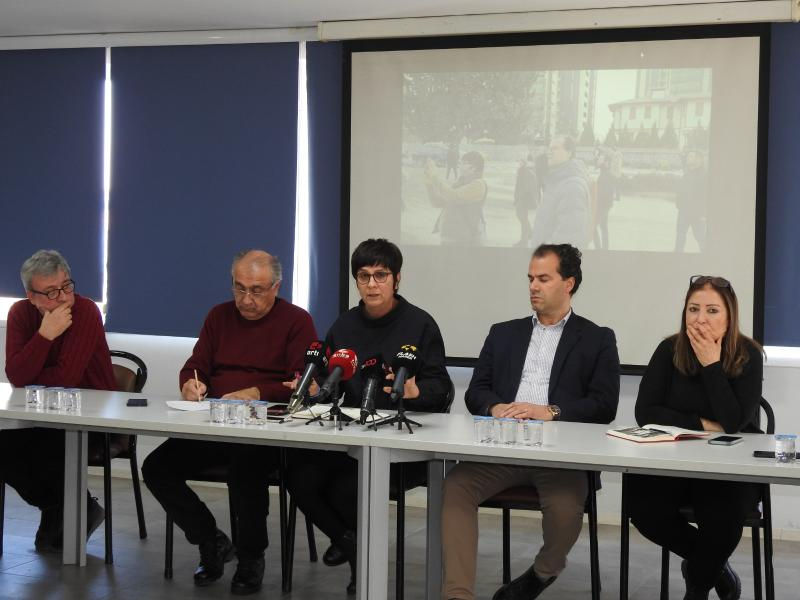
Tezcan Karakuş Candan, then chair of the Ankara branch of the Chamber of Architects, said at a press conference on 17 February 2023 that rebuilding entire cities within a year was never realistic.
"You chose the wrong settlement locations," she said. "You chose areas with soil liquefaction. You chose marshland. You opened fault lines for development. You cannot erect buildings in those places within a year. That is where all the mistakes come from."
“This country gave you 21 years. You collected earthquake taxes. You passed urban transformation laws and regulations. You implemented none of them. All these plans need to be cancelled — and new planning processes built on scientific data”, Candan said.
The delivery delays have been compounded by the scale of TOKİ's wider commitments.

The agency built 1.17 million homes between 2003 and 2022.
It simultaneously manages several large-scale social housing programmes unrelated to the earthquake: the "İlk Evim İlk İş Yerim" (My First Home, My First Workplace) scheme, announced in September 2022 and promising 500,000 units across 81 provinces over five years, had 260,000 units under construction as of January 2026.A separate middle-income scheme, "Yeni Evim" (My New Home), was announced in January 2023.
And in late 2025, another programme promising 500,000 social housing units nationwide was launched — attracting more than eight million applicants. The simultaneous demands on construction capacity, labour and materials are a structural constraint on the pace of earthquake reconstruction.
Previous earthquakes: The pattern repeats
The financing model for earthquake housing is not new, and its record is mixed.
After the Van earthquakes of October and November 2011, which killed 644 people, TOKİ delivered 17,489 homes in the urban districts and 8,500 in villages over the following decade — roughly 26,000 units in ten years.
Three-bedroom, 100-square-metre apartments were offered on two-year grace period, twenty-year interest-free loans; Erdoğan, then Prime Minister, stated in 2012 that units were priced at 110,000 lira, with the state covering 30 percent and residents responsible for 75,000 lira.
The Chamber of Engineers and Architects alleged at the time that the actual construction cost was 56,000 lira — implying a 50 percent mark-up — though this was disputed.
After the Elazığ earthquake of January 2020, which killed more than 40 people, 18,524 homes were delivered by October 2022. Monthly payments ranged from 510 to 935 lira depending on unit size — sums that reflected the lira's value at the time — on twenty-year interest-free terms.

The İzmir earthquake of October 2020, which killed 117 people, affected more than 9,000 structures.
By October 2022, 1,404 housing units and 289 commercial premises had been delivered. Monthly payments for new apartments began at 740 lira for two-bedroom units and 1,020 lira for three-bedroom units, on a 216-month repayment schedule.
But Haydar Özkan, chair of the İzmir Earthquake Survivors Solidarity Association, said in 2025 that only those classified as having "severely damaged" homes had received new units. Those with "moderately damaged" properties were still waiting.
“Moderate-damage residents were offered only a structural reinforcement loan — but ground conditions made that loan unusable. Some contractors started work, then demanded extra payment when the shell was complete. Court cases take two or three years, and nobody has the strength for that. People end up paying whatever the contractor demands”, he said.
The İzmir case is a reminder that the gap between policy announcement and experienced reality can be vast — and that it is the moderately damaged, the uninsured and the legally ambiguous cases who tend to fall through the cracks of a system designed around the clearly destroyed.
— ✦ —
The question of why earthquake housing is not free is, in the end, a question about the design of a legal system written in 1959, the compounding effects of decades of inflation, the slow-burning consequences of unresolved property title, and the fiscal arithmetic of a country that simultaneously spent 91.5 billion dollars on earthquake recovery while its citizens were still paying instalments on homes lost in earlier disasters.
None of these answers satisfies the person who spent a night in the rubble and woke up in debt. But together, they explain why three years on, 360,000 people are still in containers — and why the gap between what was promised and what was delivered remains one of the defining unresolved questions of the disaster.
(This article was first published in Independent Turkish on March 2, 2023)

Yorumlar