"Washington Knows Erdoğan — They Know What to Expect"
Richard Falk, emeritus professor of international law at Princeton University and former United Nations Special Rapporteur on Palestinian human rights, assessed Turkey's rapprochement with Israel and the Gulf, the war in Ukraine, American unipolarity — and what he calls Washington's "Monroe Doctrine for the World."

Richard Falk - former UN Rapporteur on the situation of human rights in the Palestinian territories occupied since 1967 from 2008 to 2014 - arrived in Ankara in December 2022 as one of the keynote speakers at the International Kashmir Congress, a gathering convened by the Centre for Economic and Social Research (ESAM) and the Legal Forum of Kashmir.
The conference brought together academics, lawyers and activists to examine what its final declaration described as India's "aggressive fascist methods" in the disputed territory — language that reflects the deep frustration, particularly among Muslim-majority countries, with the international community's failure to implement the UN Security Council resolutions on Kashmir that have stood, largely unacted upon, since 1948.
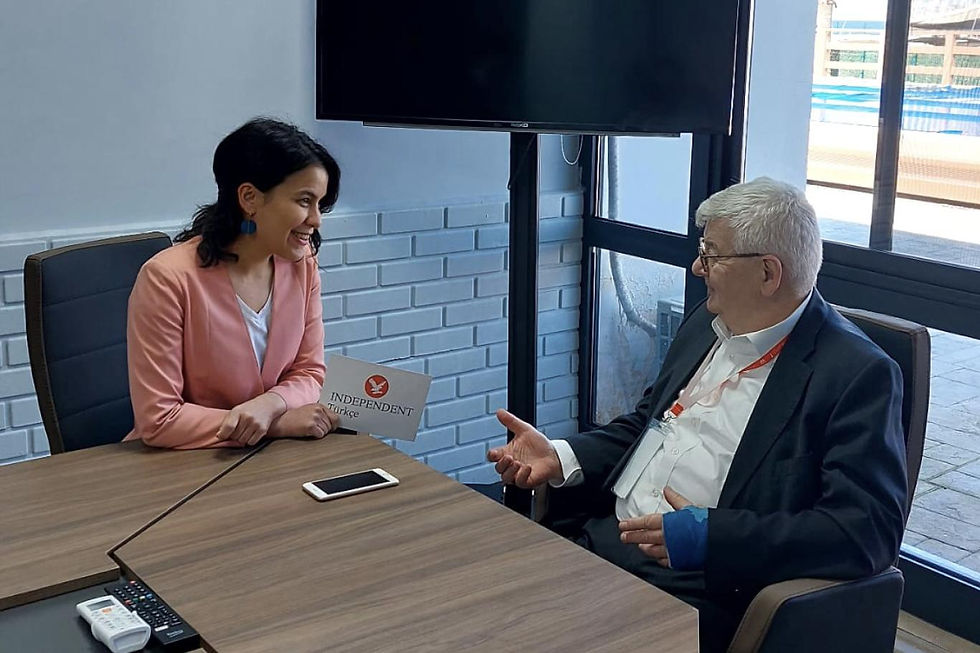
On the sidelines of the congress, Falk agreed to speak to Independent Turkish about a set of questions that stretched well beyond Kashmir: Turkey's diplomatic normalisation with former adversaries, the trajectory of the war in Ukraine, and the structure of American power in a world that is, he argues, no longer willing to be governed by it.
Turkey's diplomatic pivot
- Turkey has been working since early 2021 to repair relations with countries it had been at odds with — Saudi Arabia, the UAE, Israel. How do you interpret this normalisation process?
I think this reflects the fact that Turkey had become somewhat isolated in the previous period and was at risk of losing its position and influence in the region.
In my view, Turkey took this decision largely for economic reasons. It allows Turkey to benefit from positive diplomacy with countries that can invest significantly in Turkey and trade with it.

More broadly, it can enhance Turkey's reputation as a significant regional actor and allow it to gain some advantage during this period of economic crisis.
- Relations between Turkey and Israel have also been improving over the past year. Do you believe an Israeli-Turkish partnership in energy, trade and tourism is actually achievable — despite the Palestinian question?
In one sense I hope it does not happen — because it creates a contradiction with the cause of Palestinian liberation, which remains very popular among the people of the region even if not among its governments. This has also been an important part of Turkey's own foreign policy, which has positioned itself in solidarity with the Palestinian struggle.
After the recent Israeli elections, we are now looking at the strongest form of Zionism under a government that is openly anti-Arab and anti-Muslim. That is going to be in stark tension with the government currently in power in Turkey. I honestly don't know how Turkey will balance the pursuit of economic gain against its moral, legal and political commitments.
- So you are sceptical that this tension can be resolved into a stable balancing act?
I am somewhat sceptical, in light of the November 2022 Israeli elections. Israel now has extremist ministers responsible for internal security who will unquestionably place far more pressure on Palestinians. And the resistance to that will likely be more intense. So it will create a provocative situation.
It could even, for the first time, generate pressure on the United States to reconsider its unconditional alignment with Israel — including among American Jewish leaders who previously believed nothing could undermine their commitments. There is already hesitation among some of them.
A world no longer governed by a single power
- What is your broader assessment of where global geopolitics and the economic order are headed?
This is like looking into a very cloudy crystal ball, because the future is especially uncertain right now. It depends in the short term on whether a diplomatic path can be found to resolve the conflict with Russia, and on how ties with China evolve.

The geopolitical realignment that Russia and China are attempting to bring about is very significant. It challenges what I call the "Monroe Doctrine for the World" — the American post-Cold War condition of unipolarity, in which the United States became the only state operating beyond its own borders, projecting military and political power everywhere on earth.
The original Monroe Doctrine was for Latin America — it said no government could intervene there. Now, whether in Asia, Europe or the Middle East, anywhere in the world falls within America's self-declared global reach.
The United States maintains 800 foreign military bases. No other country comes close. It spends more on its military than the next nine countries combined. This represents a very difficult situation — massive over-investment in the military at the expense of the American people themselves. China, by contrast, is far more cautious and careful. They are not trying to project power in the same way.
(Editor's note: The Monroe Doctrine was articulated by US President James Monroe in an address to Congress on 2 December 1823. It declared that the American continents were closed to further European colonisation and that any attempt by European powers to extend their influence in the Western Hemisphere would be regarded as a threat to American security. Falk uses the term to describe what he sees as an analogous claim by Washington to a global sphere of influence in the post-Cold War era.)
- Speaking of the United States — Turkey has been governed by the same administration for twenty years now, and the relationship with Washington has been turbulent throughout. Turkey is now entering a new electoral period. How do you expect Washington to position itself toward Turkey and its government during this process?
That is difficult to say. Washington is now dealing with far more pressing issues than it was in the previous period — Ukraine, Russia, China, the problems generated by instability across the Middle East, and how to balance all of these competing concerns at once. My expectation, for that reason, is that they will not take a very strong position. On one hand, they know Erdoğan — they know what to expect from him. On the other, they disagree with certain aspects of his policies. My sense is that within the US government there are unresolved differences of opinion on those policies, and that those differences have not been settled.
Ukraine: A War That Did Not Have to Last This Long
- Do you believe the war between Russia and Ukraine will continue?
I find it deeply irrational that so little attention is being paid to the catastrophic risks this conflict carries. I have been very critical of the United States for not pursuing a diplomatic path — for not seeking a negotiated solution.
The continued provision of massive weapons to Ukraine, combined with active discouragement of any negotiation, has unnecessarily prolonged the war. It has increased the nuclear danger. And it has pushed Zelensky away from the kind of diplomatic approach that could actually resolve the conflict.
- You have also criticised American sanctions on the grounds that they harm ordinary Russian civilians.
My fundamental criticism is of the idea of defeating Russia rather than protecting Ukraine. Those are very different goals, and I think the first has come to dominate American policy at the expense of the second — and at considerable human cost on all sides.
- So a ceasefire or peace agreement in the near future seems unlikely to you?
You can never know how this geopolitical chess game will be played out. There are competing powers and competing perspectives. I would not rule anything out — but I see very little evidence, at this point, that the conditions for a negotiated settlement are being created.
(This article was first published in Independent Turkish on December 15, 2022)

Yorumlar