"The Question That Still Matters for Turkey Is: Where Do You Belong?"
Once a penniless hitchhiker crossing Anatolia, Joschka Fischer returned to Turkey in 2023 as a keynote speaker at the İzmir Economic Congress. Germany's former foreign minister spoke to Independent Turkish about Turkey's place in the world, brain drain, the NATO crisis.
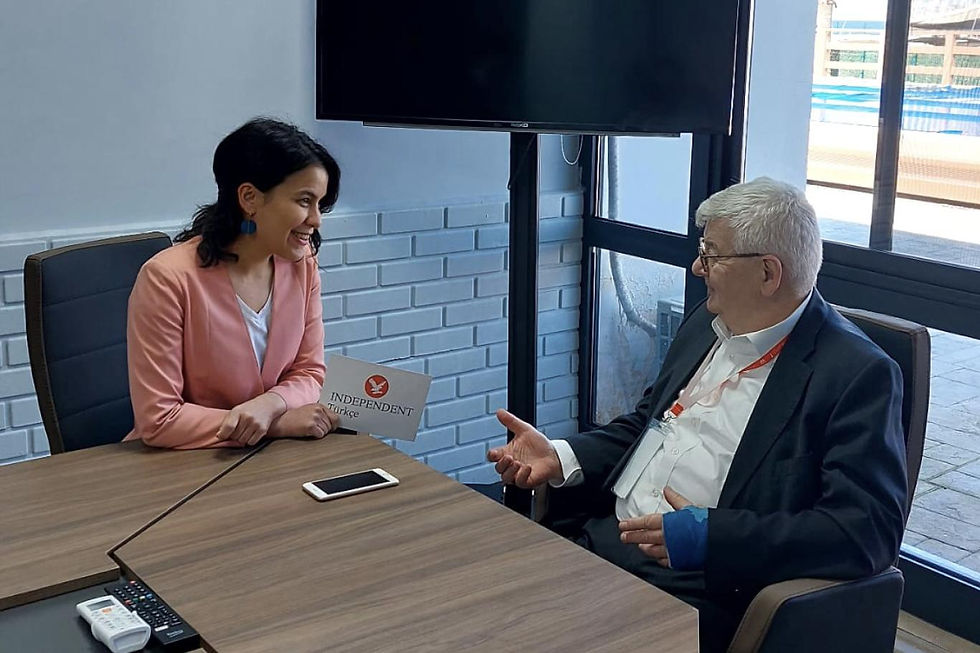
Joschka Fischer first came to Turkey in 1990ss with nothing but a rucksack and a plan to hitchhike his way through the Middle East.
He was a young anarchist who had sailed around Gibraltar on a passenger ship, passed through Marseille and arrived in Istanbul — a city that was, in his words, unmistakably oriental, and full of hippies clustering around Sultanahmet.
More than half a century later, he returned to the same country to deliver a keynote address at the 2023 İzmir Economic Congress, this time as one of the most prominent diplomatic voices in Europe.
His session was titled "An Invitation to Loyalty." The theme was familiar: Fischer spent much of his time as foreign minister arguing that Turkey belonged inside the European Union, and he was arguing it still.
"If Turkey and Europe work together, they can achieve a great deal," he told the congress.
"Rather than endlessly debating the question of full membership, if we cooperate we can build a far stronger bond. Many opportunities have been missed. We must learn from them."
After the session, Fischer sat down with Independent Turkish.
The hitchhiker who became Germany's top diplomat
"The only alternative back then was hitchhiking," Fischer said of that first visit in 1996. "I had no money, and I wanted to see the Middle East and the Mediterranean."
He had sailed around Gibraltar first, then made his way to Marseille. From there, his first destination was Istanbul — then on to Ankara by hitchhike, then Mersin, then Adana, where he and his companions received cholera vaccinations before crossing into what was then a more accessible Middle East. After Adana came Aleppo.

In Istanbul, his path crossed with Turkish workers returning briefly from Germany to visit their families in eastern Anatolia — men who had mostly arrived by train and were heading home by bus.
"They were happy to have someone they could communicate with in German," Fischer recalled. He explored Istanbul with them, and what he remembers as the hippie heartland around Sultanahmet. "It was a wonderful experience," he said. "The Turkey of that time was completely different from today's."
The difference, in his view, is not simply one of development. "Your country has developed enormously. It has an extraordinarily rich cultural heritage and remarkable cuisine. I have been impressed by your country ever since."

'From İzmir, the answer is simple. From further east, it gets complicated'
Fischer was direct when the conversation turned to the question of Turkey's geopolitical orientation — the question that has defined, and in his view continues to define, the country's strategic future.
"Look at China, the United States, India, Brazil, Indonesia — these are all large states," he said.
"The European Union is an alliance of independent states. Without it, Europeans have no future either. In the twenty-first century, size matters. For Turkey, the important question remains: where do you belong? That is a decision you must make. Not for anyone else — for the Turkish people." He paused. "From İzmir, the answer is very simple: Europe. But if you look from a city further east, the answer may be more complicated."
Fischer then asked himself a question aloud: "Do I really believe Turkey's future is oriented toward the Middle East?" And answered it: "No, I don't see it that way. But this will be a fateful decision for your country."

“Atatürk understood this very well”
Fischer has written about Turkey before, and he returned again to Mustafa Kemal Atatürk — a figure he treats not as a historical curiosity but as a strategic thinker whose logic remains directly applicable.
"Turkey's founder understood this very well," Fischer said. "Years ago, the only way to modernise Turkey and bring it to the level of the developed world was to turn toward the West. That remains a difficult task — for both Turkey and Europe. We need to restart the entire process."
On the question of Turkey going it alone, Fischer was blunt. "Because even if you are a large country and a proud one, in the context of the twenty-first century you are a small country. That option does not exist."
“Germany's greatest economic success story is tied to Turkish immigration”
The conversation shifted to brain drain — Turkey's loss and, increasingly, Germany's gain. Fischer did not soften his answer.
"We welcome them very well," he said immediately, when asked how Germany was receiving the doctors, academics and skilled professionals leaving Turkey in growing numbers. He began, however, with a comparison: the wave of Syrian refugees Germany absorbed after 2015.

"What we have experienced since 2015 is a massive influx of Syrian refugees. That is sad for Syria — because what comes to us are nurses, doctors, intellectuals. Germany benefits from this. They are making good progress: learning German, finding good jobs. But for Syria it is dramatic, because these are people who will be missed, people who will be needed."
For Turkey, Fischer acknowledged, the situation is considerably more complex. Turkish immigration to Germany has now reached a fourth generation, making Turks the country's largest ethnic minority — a fact he described not as a problem but as an achievement.
"Germany's greatest economic success story is very closely connected to Turkish immigration," Fischer said.
His example was Özlem Türeci and Uğur Şahin — the scientists behind the BioNTech coronavirus vaccine. "Two children of a poor Turkish working-class family achieved the greatest economic success of the post-war era. It was crucial for all of us — the vaccine's contribution to overcoming the pandemic was immense. A very great success story."
He also cited Agriculture Minister Cem Özdemir and Hannover Mayor Belit Onay. "There are government ministers, intellectuals, lawyers and entrepreneurs of Turkish origin in Germany. Turkish immigration has contributed enormously to my country's development." He added, with some irony: "Perhaps Turkey will replace the specialists it has lost with people from Syria and Afghanistan."
“I do not understand Turkey's position on Sweden”
Fischer was among the most prominent European voices calling for Finland and Sweden to be admitted to NATO following Russia's invasion of Ukraine — and among those most puzzled by Turkey's resistance.

"It is impossible for Turkey to block these memberships," he said. "One way or another, Turkey will say yes." After Turkey gave Finland the green light, he was direct about what remained: "I do not understand the position Turkey has taken on Sweden."
"If I were a Turkish decision-maker, I would say 'welcome' to both the Swedes and the Finns," Fischer said.
"And I would turn to all the EU members in NATO and say: 'Look, friends — now all of us, including Turkey, are in the same security family. We have work to do in the EU.' If you want a strong defence together, then we must work together. Having a strong defence is a necessity — because whether we like it or not, we have to live with Russia."
On Turkey's concerns about Kurdish militant groups, Fischer was careful but clear.
"In an alliance you can sit down and discuss everything. I do not accept the idea that Turkey's security concerns are not acknowledged at the EU level. Everyone understands these security concerns."
He added: "At the same time, you have to see the humanitarian crisis that has been unfolding in northern Syria. Syria has collapsed — but nobody I know in NATO or the EU is in favour of an independent Kurdistan. However, the humanitarian catastrophe there is a serious matter for all of us. That is why everyone needs to sit down and talk."
A brief background and update
Russia's full-scale invasion of Ukraine in February 2022 prompted both Finland and Sweden — long committed to military non-alignment — to apply for NATO membership on 18 May 2022.
Turkey blocked the applications, arguing that Sweden in particular had provided direct support to the PKK, which Ankara designates as a terrorist organisation, and had granted political asylum to its members.
A trilateral memorandum signed at the NATO summit in Madrid on 28 June 2022 committed Finland and Sweden to supporting Turkey against all security threats, including from the PKK and the organisation Turkey designates as FETÖ. Sweden confirmed that the PKK is a banned terrorist organisation.

Turkey approved Finland's NATO membership on 31 March 2023. The impasse over Sweden was resolved approximately a year later: the Turkish Grand National Assembly passed the bill approving Sweden's membership on 23 January 2024.
Following Turkey's lifting of its objection, Sweden formally became NATO's 32nd member at an accession protocol ceremony in Washington on 7 March 2024.


Yorumlar