Energy democracy: A utopia?
As countries accelerate their transition to renewable energy, researchers warn that the global energy system is still deeply tied to oil. But a growing movement argues that decentralised renewables could shift power—from fossil fuel states and corporations to citizens.

For decades, the global energy system has been shaped by oil.
But the rise of renewable energy is not just about reducing carbon emissions. For some scholars and activists, it represents something far more transformative: a redistribution of economic and political power.
The concept is known as energy democracy.
According to Jennie Stephens, a professor at Northeastern University and a prominent advocate of energy and climate justice, energy democracy is a social movement linking the transition away from fossil fuels with a broader redistribution of power.
“Energy democracy connects the shift from fossil fuels to renewable energy with the redistribution of social, political and economic power,” Stephens writes in one of her studies.
Electricity, she notes, is a multi-billion-dollar industry. The goal of energy democracy is to ensure that the financial benefits generated by energy systems remain within communities rather than flowing exclusively to large corporations.
One way to achieve that, she argues, is by transforming marginalised communities into energy producers themselves.
“The transition to renewable energy is about much more than reducing carbon emissions,” Stephens says. “Renewable systems can provide social benefits such as household employment and cooperative ownership.”

From ‘consumer’ to ‘prosumer’
The roots of this idea go back decades.
In his influential 1980 book The Third Wave, the American futurist Alvin Toffler described a new type of economic actor: the “prosumer”—a person who both produces and consumes.
Toffler illustrated the concept through an example from India. The late social scientist Jagdish Kapur had transformed an unproductive 10-hectare plot into a solar-powered farm with a biogas facility capable of producing enough wheat, fruit and vegetables to feed both his family and workers while generating surplus food for the market.
At the same time, engineers at the Indian Institute of Technology were designing small 10-kilowatt solar installations for villages—systems capable of powering lighting, water pumps and household electronics.
Nearly 40 years later, that idea has become central to discussions about energy democracy: households and small businesses generating electricity through solar panels or local renewable systems.
There is also fear, not just idealism
Yet the rapid growth of renewable energy is not driven solely by a desire for a fairer world.
According to economist Caner Özdurak, an associate professor studying sustainable finance and energy markets, another powerful factor is fear within oil-dependent financial systems.
In his research on renewable investment dynamics, Özdurak found that the expansion of clean energy is still closely tied to the behaviour of the oil market.

When oil prices fall, market anxiety rises—and renewable investments often increase.
“The push toward renewable energy is not driven purely by the belief in a more just world,” Özdurak said. “We are still operating in a market structure deeply connected to oil.”
Özdurak explained that he examined the relationship between oil, renewable energy investments, and the fear index, noting that according to S&P's clean energy index, when oil prices fall, the fear index (VIX) rises and renewable energy investments increase.
"Of course, there are targets set regarding carbon footprint. Of course, the trend towards renewable energy is increasing," said Özdurak, continuing:
"However, from an economic perspective, that is, from the point of view of profit maximization, the situation in oil cannot be explained by financial returns. There is a power structure there. Whoever controls energy also controls the government.
There is an autocratic agenda, and actions are taken accordingly. It is clear that this agenda does not aim at ‘making the world a better place.’ Therefore, when prices fall, market stress increases, investment in renewable energy increases, and this movement stops at a certain point.
At the beginning of the research, I expected a result indicating that investment in renewable energy would increase in an environment where market volatility was low and the atmosphere was calm. However, the opposite happened.”
Oil and political power
Özdurak’s work also suggests that the growth of renewable energy investment may depend less on a country’s wealth and more on whether it is governed democratically or under authoritarian rule.
Among the world’s ten largest oil producers are the United States, Saudi Arabia, Russia, Canada, China, Iraq, the United Arab Emirates, Brazil, Iran and Kuwait.
Apart from the United States, which produces 20% of the world's oil and is governed by a "flawed democracy," Canada, which has a full democracy, and Brazil, which holds 4% of global production and is governed by a hybrid regime, seven out of ten countries have authoritarian regimes.

In such systems, energy resources are not just an economic asset but a political one. “Whoever controls energy often controls governance as well,” he added.
Renewable energy, by contrast, has the potential to decentralise power.
“Solar energy can be produced at home or by small businesses,” Özdurak said. “That means the power associated with controlling oil resources could gradually spread to society.
Politics and the clean energy market
Energy markets can also respond sharply to political shifts.
Özdurak points to the political transition in the United States following the 2020 presidential election. During his first presidency, Donald Trump withdrew the country from the Paris Climate Agreement and received strong backing from major oil companies such as ExxonMobil.
But as it became clear that Joe Biden would take office—promising a stronger climate agenda—renewable energy stocks surged.
“When events occur that redefine renewable targets, investment in clean energy companies rises,” Özdurak said.
Yet he also notes that when market uncertainty fades, investments often drift back toward fossil fuels.
Democracy and the distribution of wealth
For Özdurak, the importance of democracy in the energy transition lies not simply in economic growth.

“Democracy may produce higher GDP levels,” he said. “But its real significance lies in distributing growth and wealth more fairly across society.”
In that sense, renewable energy is not only an environmental solution but potentially a political and economic equaliser—a tool that could weaken the geopolitical leverage of fossil fuel states.
The red dot in the graph below represents China, one of the countries with the highest gross domestic product among the approximately 130 countries studied. However, this country remains in the red, authoritarian zone.
The United States, shown as a dark blue dot, is closer to the red global average line, the region with a more equitable income distribution, even though it has a "flawed democracy."
The case of Turkey
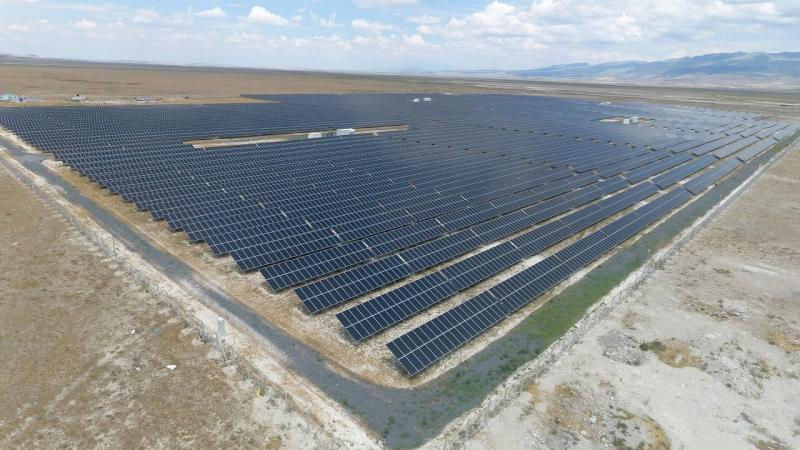
In Turkey, renewable energy capacity has expanded rapidly over the past decade.
According to the 2020 “Renewable Energy Statistics” report from the International Renewable Energy Agency (IRENA), the country’s renewable energy capacity rose from 17,369 megawatts in 2010 to 44,587 megawatts in 2019.
However, 63% of this capacity comes from hydroelectric power, a source that remains controversial due to environmental concerns.
Wind power accounts for roughly 17% of renewable capacity, while solar energy represents about 13%. Biogas and geothermal power contribute smaller shares.
Despite this growth, fossil fuels remain dominant. According to data from the London-based climate think tank Ember, 57% of Turkey's electricity generation in 2020 still came from coal and natural gas, while renewables accounted for around 43%.
The cost of going green
Government policies have played a crucial role in shaping the country’s renewable energy sector.
Under the Renewable Energy Support Mechanism (YEKDEM), introduced in 2005, the state guaranteed purchase prices for electricity generated from renewable sources such as wind, solar, geothermal and biomass.
These incentives initially paid producers in US dollars—an arrangement that helped trigger a wave of investment.
“At one point, renewable energy became extremely popular because investors were receiving dollar-based returns,” Özdurak said.
Landowners converted farmland into solar power sites, small projects were merged into larger installations and investors from outside the traditional energy sector entered the market.
“It began to resemble the real estate sector,” he said. “People started calculating the cost of land, panels and intermediaries rather than focusing on environmental goals.”
In 2021, however, the support scheme shifted from dollar-based payments to Turkish lira, and investment momentum slowed as investors waited to see how the new tariff system would evolve.
A greener tariff—with a higher bill
Consumers in Turkey can also choose to buy renewable electricity through a “Green Tariff” programme launched in August 2020.
Households selecting this option receive electricity certified as coming from renewable sources, with a label indicating its origin.
But critics say the programme has made clean energy more expensive.
According to Ahmet Akın, politician and energy specialist), customers using the green tariff have at times paid up to 88% more than those on standard electricity plans.

As energy prices rose throughout 2021, he argued, the programme lost much of its incentive value.
A system still tied to oil
Despite rapid growth in renewables worldwide, the global energy economy remains deeply connected to fossil fuels.
For researchers like Özdurak, the question is whether renewable energy will simply become another component of the existing system—or whether it will genuinely redistribute power.
In other words, the future of energy may hinge on whether energy democracy becomes reality.
If it does, renewable technologies could do more than reduce emissions—they could fundamentally reshape who controls the world’s energy resources. ⚡
(This article was first published in Independent Turkish on June 18, 2021)


Yorumlar