From wheelbarrows to urinals: divers pull decades of waste from Istanbul’s seabed
Despite signs of improvement in water quality, volunteer divers in Istanbul say the city’s seas still conceal thousands of tonnes of rubbish — from tyres and batteries to construction debris — highlighting the scale of marine pollution.

More than two decades after the United Nations declared 22 March as World Water Day, the planet’s clean water resources remain under growing pressure.
According to UN data, only 2.5% of the world’s roughly 14 billion cubic kilometres of water is drinkable. Around 750 million people lack access to clean water — a population nearly two and a half times that of the United States.
At the same time, roughly two million tonnes of waste are dumped into water sources every day worldwide. Scientists warn that because groundwater and surface waters are interconnected, pollution in rivers, lakes and seas can rapidly contaminate broader water systems.
Divers turning pollution into evidence
In Turkey, one organisation trying to highlight the scale of the problem is the Underwater Cleaning and Awareness Movement Association.
Since 2005, the group has organised diving operations across the country — particularly in İstanbul — to remove solid waste from the seabed and display the items in public exhibitions designed to raise awareness.
According to the association’s president, Hakan Tiryaki, the goal is not simply cleaning the sea.

“Marine pollution is a very broad concept,” he said. “It includes oil pollution, radioactive contamination and microbiological pollution — things you cannot easily show people.”
“Solid waste, however, makes pollution visible. What we do is place whatever we find underwater in front of people, especially in crowded urban areas. In that sense, what we are doing is not cleaning — it is sampling.”
Signs of improvement — but deeper concerns
Over the years, the group has carried out numerous dives along Istanbul’s shores, including at Harem, Caddebostan, Golden Horn, Eminönü and Karaköy.
Tiryaki says the situation has improved compared with past decades, though the long-term outlook remains worrying.
“We live in a city where, until 1953, municipal waste was dumped directly into the sea,” he said. “By the late 1980s the pollution was severe — you couldn’t swim anywhere in Istanbul.”
“The picture started to change in the early 2000s,” Tiryaki implied. “Since 2005 we’ve even been able to dive in places that would have been unimaginable before.”
But he warns that the number of swimming areas is not necessariliy the measure of sea cleanliness.
“Municipalities and institutions can work as much as they want,” he said. “Yet I still pull wheelbarrows and even urinals from the seabed.”
He also believes deeper areas of the Bosphorus remain largely unstudied.
“I’m convinced that at depths of around 40 metres, the levels of streptococcus and coliform bacteria would be extremely high,” he said.
Measuring water quality
Streptococcus and coliform bacteria are among the key indicators used to assess seawater quality.
Under European Union standards, seawater is considered clean only if streptococcus bacteria levels remain below 400, while coliform bacteria — commonly associated with E. coli contamination — must remain below 1,000.
Yet measurements in parts of Istanbul have been far higher. A 2014 study by Kadıköy Municipality found coliform levels of 2,000 at Caddebostan beaches, while readings near Yoğurtçu Park reached 570,000.
Pollution spreads beyond a single city
For Tiryaki, marine pollution cannot be seen as a local problem.
Waste in the Sea of Marmara can travel through the Bosphorus into the Black Sea via Mediterranean currents.
“What begins here becomes a problem for six countries and nearly 160 million people,” he said.
Thousands of pieces of waste recovered
Since 2005, divers from the association have recovered an extraordinary variety of items from the seabed.
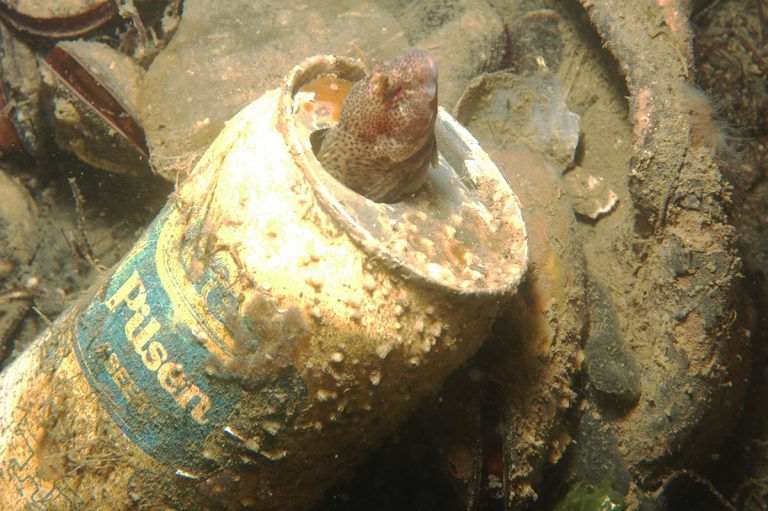
Among the finds are municipal concrete planters, park benches, thousands of beverage cans and bottles, mobile phones, truck batteries and even animal bones.
The organisation has catalogued tens of thousands of items over the past decade, though Tiryaki says the true scale would be far greater if measured by weight rather than number.
One example is the Harem Project, carried out between 2006 and 2010.
During the project, divers recovered 15,000 pieces of waste from the waters around the Harem ferry terminal, including 17 truck batteries, 200 heavy machinery tyres, structural steel from the demolished Harem pier and 80 sacks of rubble.
What divers leave behind
Not every object found underwater is removed.
If removing an item would cause more harm than good — for instance if it has become integrated into the seabed and serves as habitat for marine life — it is left in place.
The same applies to very heavy objects encountered during winter dives, where attempting removal could endanger divers or waste valuable time.
Divers also avoid barrels containing liquids or objects that may have criminal significance. Such items are marked underwater and reported to the relevant authorities.
Tyres: a hidden environmental threat
Among all the debris found underwater, Tiryaki says discarded tyres pose one of the greatest risks.
According to the National Oceanic and Atmospheric Administration in the United States, plastic bottles and diapers can take around 450 years to decompose in the ocean. Aluminium cans take about 200 years, while fishing lines can persist for 600 years. Glass may last indefinitely.
Tyres can also take centuries to break down.
Although Turkey introduced regulations in 2006 governing the transport and recycling of used tyres, rubber buffers used on docks were exempted from licensing requirements. As a result, Tiryaki says many are eventually dumped into the sea.
“There are tens of thousands of tyres in Istanbul’s waters, and the number keeps growing,” he said.
“A car tyre contains about 70% rubber and can take 450 years to decompose. During that time it releases 12 heavy metals into the environment.”
“People think the tyre will simply disappear one day,” he added. “But for 450 years it continues poisoning everything around it.”

A fragile hope for the future
Despite the grim picture painted by official data on global water pollution, Tiryaki believes there is still hope for Istanbul.
One encouraging sign has been the return of dolphins to the Bosphorus, which had rarely been seen there for years.
For Tiryaki, however, the lesson is clear: protecting the seas requires shared responsibility.
“We don’t have the luxury of shifting the blame entirely onto institutions,” he said.
“The sea belongs to all of us. If you have a right to it, you also have a responsibility. The moment you turn your back on that responsibility, you become part of the problem.”
(This article was first published in Al Jazeera Turk on December 6, 2014 and re-published in memory of Hakan Tiryaki whom we lost in 2025. R.I.P.)


Yorumlar