First Turkish opera, lost masterpieces and a century of witness
The building that Atatürk dreamt of, where Turkey staged its first opera and where Reza Shah wept at the curtain call, has spent decades haunted by a different kind of drama: hundreds of paintings stolen, copied, distributed to bureaucrats and sold through criminal networks. A full account of one of Turkey's most remarkable institutions — and its most painful wound.

It was the winter of 1927, and the second floor of a new building on Namazgâh Hill in Ankara was taking shape. Snow was falling hard.
The foreman, a prominent architect named Arif Hikmet Koyunoğlu, was overseeing work on the balcony when one of his labourers called out: "Sir — the Pasha has arrived." Koyunoğlu turned to find Mustafa Kemal standing beside him, head and shoulders white with snow.
The greatest stonemason of the age, Hüseyin Efendi — who had lost one arm at the Battle of Afyonkarahisar — grabbed a broom and began brushing snow from Kemal's coat. The founder of the Turkish Republic asked the man what had happened to his arm, and on being told, was visibly moved.
Someone had been boiling tea in a pot on site; there were no proper cups. Kemal ladled himself tea with a wooden spoon. Then he pointed from the balcony toward the horizon: "Hikmet," he said, "that empty space over there — I'll make it a forest farm. And that marsh — a park." Years later, Koyunoğlu realised he had been looking at what would become Atatürk Forest Farm and Gençlik Park.
The building Kemal visited so often — sometimes deep in winter, sometimes past midnight, telling the architect simply that he had seen a light from the road — was the General Headquarters of the Turkish Hearths Society.
Today, after a century of extraordinary use and extraordinary misuse, it is better known as the Ankara Museum of Painting and Sculpture. Its story is inseparable from the story of modern Turkey. So, unfortunately, is the story of what went missing from its walls.

A building that outlived its purpose
The Turkish Hearths — Türk Ocakları — were cultural and civic associations founded in the early twentieth century with a stated aim of keeping politics at arm's length.
Their founding charter declared that the organisation would not engage in political activity, and that no member could use it for political ends. In the turbulent years of the late Ottoman Empire and the early republic, that neutrality proved impossible to maintain.
The Hearths had witnessed the Second Constitutional Period, the First World War and the founding of the Grand National Assembly. They received state backing and held real institutional weight. But when some of their members drifted toward the Free Republican Party — a short-lived opposition movement that Atatürk himself had sanctioned before dissolving it after just three months — their fate was sealed.
In March 1931, Atatürk declared that the Hearths should merge fully with his Republican People's Party. On 10 April 1931, their final extraordinary congress voted the organisation out of existence. All their rights, buildings, objects and collections passed to the party.
The Headquarters building on Namazgâh Hill, built specifically to house the Hearths, had served that purpose for barely four years.
The night a Republic staged its first opera
From February 1932, the building was repurposed as the Ankara People's House — one of the state-sponsored cultural clubs the government opened across Turkey.
The lecture halls and exhibition spaces that had hosted scientific and artistic events continued to do so, now under a different name.
It was in this building, in June 1934, that one of the most symbolically charged evenings in early republican history took place.

Reza Shah Pahlavi of Iran was making a state visit to Ankara — the first in years, and an opportunity to repair a relationship that had grown badly strained. Atatürk arranged for a specially commissioned opera to be performed in the Shah's honour. The composer Ahmet Adnan Saygun and lyricist Münir Hayri Egeli produced the work — Özsoy, on the theme of Turkish-Iranian brotherhood — in a matter of weeks. It was the first opera ever staged in the Turkish Republic.
When the curtain fell on 19 June 1934, Pahlavi embraced Atatürk and called him "brother." The Shah's month-long visit became the turning point in bilateral relations that Atatürk had sought. The former Turkish Hearths headquarters had served as the stage.
A death and a war brought silence to the museum
Museum activities in Ankara, which lasted from the 1920s to 1938, were interrupted by Atatürk's death and the start of the Second World War, and evolved in a different direction with the Democratic Party's rise to power in 1950.
The Democratic Party government closed People's Houses nationwide and returned the building to the reconstituted Turkish Hearths.
Between 1952 and 1975, the building passed between the Turkish Hearths, the State Theatre, Ankara Municipality, the Ministry of Village Affairs, the Ministry of National Defence and the Ministry of Education.

Restoring a euin — with a 92-Year-Old Architect
By the mid-1970s, the building had suffered decades of institutional neglect.
It had been a barber's shop at one point — the elegant Turkish Room that Koyunoğlu had personally decorated, following Atatürk's instructions, converted for the purpose. The main entrance had been demolished. When officials came to discuss its future, they found the structure deeply degraded.
The push to make it a museum came from an unlikely combination: President Fahri Korutürk, who reportedly said he wanted it finished before he left office, and his wife Emel Korutürk — herself a painter, and a member of the distinguished Cimcoz family, one of the most influential names in Turkish cultural life. It was Emel Korutürk who took a particular interest in saving the building.
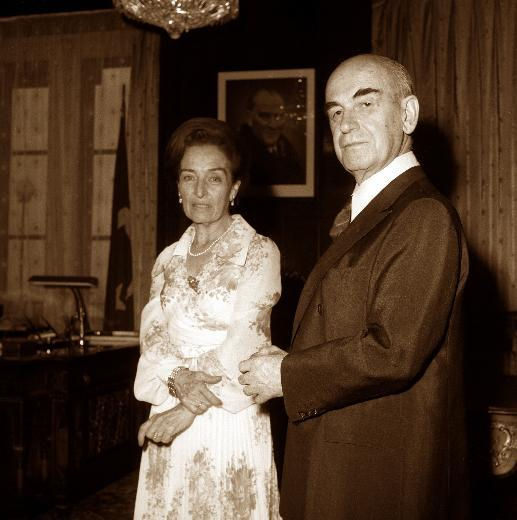
In December 1975, a young official from the General Directorate of Fine Arts drove to Galata in Istanbul to call on the building's original architect. Arif Hikmet Koyunoğlu was 92 years old.
He described the sensation of being asked to help restore his own most significant work: "I felt like a young man again."
The journey from Istanbul to Ankara took sixteen hours by car, with rest stops along the way, accompanied by the Director-General of Fine Arts, Mehmet Özel. When Koyunoğlu saw the state of the building, he was devastated. He gave his instructions and authorisations, and handed the detailed restoration work to architect Abdurrahman Hancı, maintaining contact throughout.

Work began in late 1976, slowed by budget constraints, received supplementary funding in 1979 and was completed in time for a formal opening on 2 April 1980 — conducted by President Korutürk himself, just as his wife had hoped.
The collection that was assembled in 40 days
Before the museum could open, it needed art.
Teams of painters were assembled — led by celebrated figures including Eşref Üren, Arif Kaptan and Turan Erol — and dispatched to comb through every government ministry in Ankara.
In forty days, they identified 800 works. A prime ministerial circular ordered these works collected from wherever they were being held. Of the roughly 800, some 500 were deemed of sufficient quality for a national museum and immediately sent for conservation.
The Istanbul Museum of Painting and Sculpture — which had opened in 1937 — was also approached. According to painter and academic Yusuf Taktak, who was working at the Istanbul museum at the time and has spent fifty years in the profession, a selection committee that included Adnan Çoker, Sabri Berkel and Hüseyin Gezer chose 100 paintings and sculptures to transfer to Ankara. A catalogue was compiled and an agreement signed.
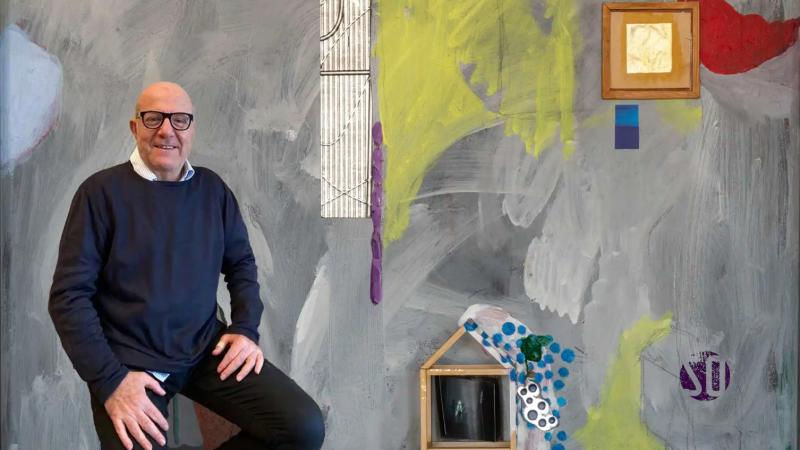
Taktak recalls objecting at the time — "I was young and angry, asking why we were giving them away" — and being reassured by his mentor Adnan Çoker that the works would be returned. "None of them ever came back," he said.
"Adnan Çoker was my teacher. He told me: 'Don't say that, Yusuf. Opening a museum in Ankara matters. These will be returned.' None of them ever came back, he said.
The artworks that were distributed like furniture
Taktak describes how what began as curatorial oversight evolved into something more troubling.
Mehmet Özel, the Director-General of Fine Arts, made frequent visits to the Istanbul museum.
"At first," Taktak said, "I thought he was simply keeping an eye on the collection. But it gradually became clear that he was noting down the names of specific works. A week later, orders would come from Ankara: 'We want these paintings.'"
Taktak says he tried to resist. When a painting by Nazım Ziya was requested, he sent a different, lesser work from storage instead. The museum director received a reprimand from the presidency for this.
"I did what I could," Taktak said. "But they went, and they never came back. They were always taken supposedly for the Presidential Residence, or this palace or that. In other words, works from a museum open to the public were taken out to serve as interior decoration in institutions and official residences."
Bedri Baykam, the painter and president of the International Association of Plastic Arts, described a pattern that he says has persisted across administrations: "For years, senior officials in Ankara have called up and said, 'Send us some paintings.' The works are signed out. They are described as going on temporary loan. They are never seen or heard of again."
"If a painting is to be displayed for four years in a state institution or palace, it must be returned to the main central museum," says Bedri Baykam.
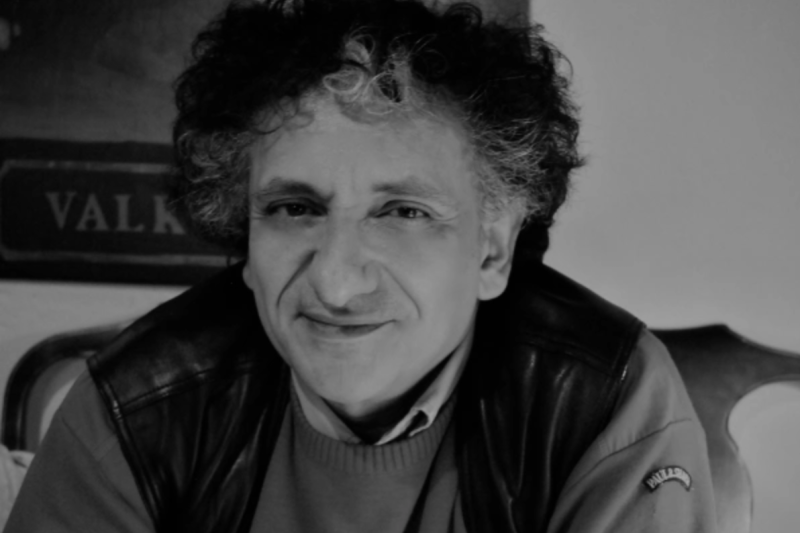
"The people responsible for museums also change every 3, 5, or 10 years” he reminded, “There is no one left to follow up, and eventually a moment comes — after a painting has been hanging on that institution's wall for 10, 15, or 20 years — when those people move to claiming ownership: 'this painting is mine.'”
"Art has never been a priority in Turkey," Baykam said and he pointed in his criticism of successive governments.
"I have nothing against mosques being built in any district or neighbourhood," he said. "But if a state builds 110,000 mosques and not a single modern art museum in the same period, that is a score of 110,000 to zero."
He argued the indifference cut across political lines — from the governments that followed Atatürk and İnönü through to Demirel, Özal, Menderes, Çiller, Erbakan and the current AKP administration, which has now held power for 22 years.
"The one thing they all have in common," he said, "is that whenever art comes up, the answer is always the same: now is not the time. We have bigger problems. This is not what the public wants. This will not win us votes."
The first minister to name the problem
Between 1980 and 2018, some repairs were made to the building due to structural deterioration. In 2018, restoration work in line with modern museology principles was initiated. The museum was finally reopened to visitors on December 28, 2020.
Ertuğrul Günay served as Minister of Culture and Tourism between 2007 and 2013.
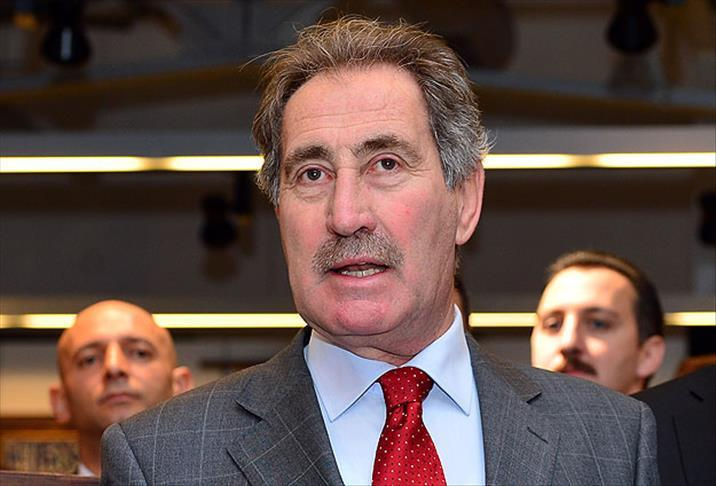
In 2010, he stated publicly that audit reports — approved by ministers and dating from the mid-1980s to the early 2000s — documented works having been sent from the museum to high-ranking officials to "decorate their offices."
In 2012, when press reports claimed 202 works were missing, Günay corrected the figure upward: "It's not 202. There are problems with nearly 300 works." Some were missing outright, he said; others were suspected forgeries.
Günay consistently pointed to the post-1980 military coup period as the starting point for the crisis.
His successor, Ömer Çelik — appointed in January 2013 and now the spokesperson for the ruling AKP — updated the figure further.
In November 2014 he told reporters that 302 works were missing or of doubtful authenticity, that 43 had been confirmed as forgeries, and that two operations had recovered a total of 60 works valued at roughly 50 million lira.
Ömer Çelik, repeated that there were many abuses during the 1980s, said, "Because controls were not done properly and the system collapsed in Türkiye, during the coup periods, artifacts were taken and placed in people's homes, and then their traces disappeared. Supposedly, they were sent for exhibition and display, but then their traces were lost."

Çelik, also stated that there might also be well-intentioned buyers, reminded that the artifacts stolen years ago might have been given new identities, may have changed hands many times, and finally, that well-intentioned, sincere buyers who were unaware of this might have paid money for them and he asked those people to cooperate with the government.
Namık Kemal Zeybek, who served as Culture Minister from 1989 to 1991 and now leads the Ata Party, told Independent Türkçe that reports of missing works had reached him during his own tenure.
He referred the matter to the Inspectorate, which concluded the allegations were serious enough to send to a prosecutor. "Mehmet Özel was investigated and acquitted," Zeybek said. "The judge found no fault on his part. From the Ministry's perspective, the matter was closed."
Mehmet Özel's account: The damage was already done
The figure of Mehmet Özel — who spent 29 years as Director-General of Fine Arts, worked under 28 ministers and six presidents, and died in 2017 — sits at the centre of the museum's troubled history. He himself left a written account.
In September 1975, an Italian art critic contacted the General Directorate looking for a painting by the celebrated nineteenth-century Turkish artist Osman Hamdi Bey, known as The Arms Dealer, which he wanted to reproduce in a book.
Özel's research showed the work had at one point been in the Turkish Hearths building, which by then was being used as an evening art school.

When he entered the building, he found it badly deteriorated. Staff told him the painting "might be in storage." In the storeroom, amid years of accumulated junk, he found both The Arms Dealer and The Tomb of Timur by Vasily Vereshchagin — both with broken frames, both rotting from damp. He and a colleague cleaned them and asked the staff to hang them on the walls.
When the building was finally vacated in April 1976 and a commission established to document its contents, the picture was worse. "Apart from a few damaged old paintings," Özel wrote, "nothing was found. The inventory registers and everything from the earlier period had disappeared."
The 2005–2008 theft ring: Forgeries, a "counterfeiting workshop" and a secret witness
If the disappearances of the 1980s and 1990s were the product of institutional drift and patronage networks, what happened between 2005 and 2008 was something more deliberate and more calculated.
The immediate trigger came in January 2009, when a security guard named Veli Topal was detained on suspicion of removing three paintings from the museum's storage — among them a portrait of Osman Hamdi Bey by İbrahim Çallı and a work depicting the Cimcoz family.
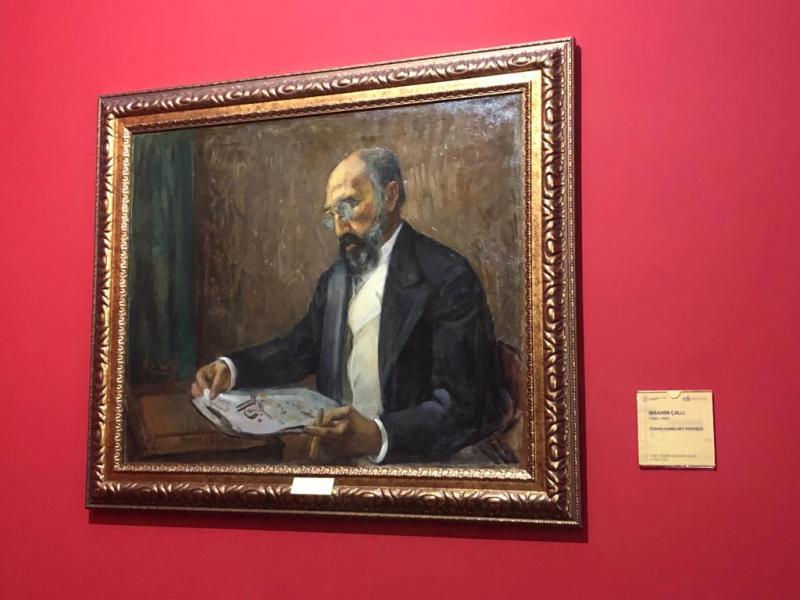
The tip-off came from a forensic appraiser, Professor Dinçer Erimez, to whom Topal had brought the works to be valued. Topal was then observed leaving the paintings in the museum car park by attendants.
It later emerged that Topal had previously been linked — while on duty at Topkapı Palace — to individuals suspected in a separate theft of artefacts worth millions of dollars. Despite an ongoing court case at the time, he had been transferred to Ankara.
The full scope of what had happened during the 2007–08 renovation only became clear over years of tangled bureaucratic process.
In October 2007, while Altındağ Municipality was carrying out the restoration, two sculptures were stolen in broad daylight.
The Ministry dispatched inspector Fuat Şen to investigate the status of the paintings as well. Şen submitted a report stating that no works were missing. But when Özgür İzzet Pektaş was appointed museum director in November 2007, he demanded a fresh count. Şen was again put in charge, this time heading a commission. That commission found discrepancies. Pektaş brought a legal case against Şen over his initial "no missing works" report.
The commission led by Şen was then dissolved, and a new commission formed in 2008 to start the count again from scratch. Examining each work individually was enormously time-consuming; the count was interrupted repeatedly and dragged on for years.
Throughout this period — as experts later noted in forensic reports submitted to Ankara's 16th Court of First Instance — conditions inside the museum were deeply inadequate. Keys were not being properly secured. And the security alarm system installed in the storage area had been broken since the beginning of 2008, a fact of which authorities had been warned.
In 2010, thirteen pencil-and-charcoal sketches by the revered painter Hoca Ali Rıza were found to have been replaced with forgeries. The museum director reported this to police. The Ministry confirmed both the forgeries and the discovery that five cardboard mounts were empty.
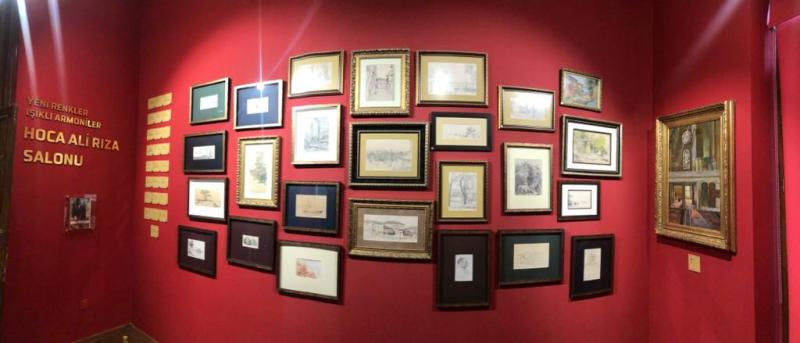
Meanwhile, a source using the code name "Günışığı" — "Daylight" — emerged. An antiques dealer based in Istanbul, Günışığı told prosecutors he knew the whereabouts of nearly 170 works, and would reveal them if his personal safety could be guaranteed. According to his account, the paintings had been stolen by an organised criminal group between 2005 and 2008 and sold on through the antiques market.
In December 2012, Günışığı provided his documents and information to Ankara public prosecutor Hakan Yüksel. Yüksel launched a comprehensive investigation, working with the Ankara police anti-smuggling unit and Ministry experts to trace the works.
Raids in 2013 recovered 43 paintings — valued at 12 million 76 thousand lira at the time. A further operation in November 2014 — spanning Istanbul, Ankara, Mersin and Eskişehir — detained 18 people, including businessmen, collectors, former museum staff, and gallery and auction house owners. Seventeen more works were recovered. Nine people were remanded in custody, among them Veli Topal.
How the operation worked
According to the account that emerged through testimony, the scheme began when a businessman named Ahmet Sarı — who had gone bankrupt and was in financial difficulty — made contact in 2005 with his friend Topal, then working as a guard at the museum.
Sarı proposed that Topal remove works from the museum's storage and bring them to him; Sarı would sell them to dealers and auction houses and pay Topal a commission per painting.
Topal's own statement denied direct involvement. In his testimony he said he ran a small kiosk — a detail that underscored his claimed distance from the world of high-value art dealing. "If I had turned a blind eye to the removal of so many items from here, my situation would not be this bad," he said. "I still rent my home. I have significant debts and expenses."

He presented himself not as an initiator but as someone who had been approached — and who, by his own account, had not profited from the scheme in the way others had. According to testimony reported in Milliyet, Topal told Sarı: "If you find us customers from Istanbul, we can give you original paintings by Ottoman and Turkish artists sitting idle in the museum's storage — some on the inventory, some not. You sell them. We all benefit." He later denied making this offer.
Artifacts worth $250 million were sold to antique dealers for very low prices
The first works removed, in 2005, were two oil paintings by the celebrated late Ottoman painter Halil Pasha.
Sarı sold these to an Istanbul antiques dealer, Mete Aktuna, whose mother was herself a prominent figure in the antiques trade. Aktuna subsequently acquired 80 more paintings — all, according to prosecutors, removed from the museum's storage. He sold some privately, others through auction, to prominent collectors and businesspeople.
Aktuna stated in his testimony that he did not know that the artifacts he bought and sold were stolen.

It was revealed that Topal and Sarı sold artifacts, which were said to be worth $250 million at the time, to antique dealers and gallery owners at very low prices. These sales, even reaching auction levels, were facilitated through forged documents.
"A 'forgery atelier’ has been established in Istanbul"
To avoid detection, the stolen originals were replaced with copies. According to Günışığı's statement, the forgeries were produced by specialists brought from the Aivazovsky Painting Academy in Crimea, working in an apartment in Istanbul that had been converted into a studio for the purpose.
Gallery owner Orhan Dağhan Özil — arrested in December 2014 on charges including leading a criminal organisation and aggravated breach of trust — denied the allegations against him in their entirety. He rejected Günışığı's account, saying he had met Ahmet Sarı only twice. He categorically denied that he and Mete Aktuna had rented an apartment together in Istanbul or arranged for specialists from Crimea to produce replacement copies of stolen works.
How did a former prime minister involved?
In his defence statement, Özil described how he had come to be involved at all.
A man he knew — a cousin of former Prime Minister Mesut Yılmaz, he said — had approached him with a tip: that a significant number of paintings had been stolen from the Ankara museum, and that they were now in the collections of well-known businesspeople. The man suggested that if Özil helped identify the collectors, substantial sums of money could be extracted from them. Özil said he rebuffed the approach: "I told him: go to the prosecutor's office. If you know something, report it there. I want no part of this." He added that the man's circumstances had deteriorated in recent years, and he suspected his motives.
Özil said that when the investigation became public, he panicked — as did many in the auction and gallery world. He contacted dealers with whom he had done business and asked whether any of the works he had bought or sold might have come from the museum. He identified five such works and surrendered them.
In a 2020 interview with the arts publication Sanatatak, he said he had gone voluntarily to give his statement to the prosecutor and was arrested mid-interview, before his testimony was complete, following an argument. "There was no arrest warrant for me," he said. "I went of my own accord to shed light on the matter." He maintained that the five works he had handled had been acquired and sold with the knowledge and authorisation of the Ministry of Culture. "If there is a party responsible here," he said, "it is the Republic of Turkey's Ministry of Culture."
The investigation, the indictment and the lingering questions
The investigation concluded in 2016. Nineteen suspects faced prosecution.
The indictment, drawn up by prosecutor Murat Korkmaz, stated that museum staff — including deputy director Akile Ayla Tuncay, researcher Gazi Doğan and guard Veli Topal — had removed 79 paintings from storage between 2006 and the discovery of the scheme, with a combined value at the time of 18 million 860 thousand lira.
Ahmet Sarı, identified as the organiser, stated in his testimony that all the collectors who had bought and sold the stolen works had known they were stolen. The indictment named Sarı, Özil and Aktuna as alleged organisers, with 14 others charged as members of the criminal group. A separate investigation remained open regarding 44 further suspects, including the former museum director.

On 8 May 2017, 63 recovered works were displayed at the museum under the exhibition title “I Am Home: A Story of Return”. Paintings by Hikmet Onat, Feyhaman Duran, Şevket Dağ, İbrahim Çallı, Sami Yetik, Hoca Ali Rıza, Halil Pasha and Bedri Rahmi Eyüboğlu were among those returned.
Veli Topal's death — and the questions it raises
Murat Emir, a member of parliament for Ankara from the main opposition Republican People's Party, has pursued the missing-works case in the legislature for years.
In a July 2020 interview, he revealed that Veli Topal — the security guard whose arrest had set the investigation in motion — had subsequently died by suicide. Emir said he considered the circumstances suspicious.

Emir also raised questions about the broader accountability gap. "The prosecutor says the 58 paintings are worth 250 million dollars," he said. "There is a hand protecting ministers, under-secretaries, senior directors. Every time we push further, something new emerges. And yet from the Ministry, not a single satisfactory answer."
He questioned whether the theft could have been carried out by a single guard working alone. "Even if that theft had never happened, there are still missing works," he said. "The guard was just the visible surface."
The 40 that remain
The Ministry of Culture and Tourism currently lists 40 works as missing on its website.
Senior museum officials told Independent Turkish that this is the current figure, and that the investigation file opened in 2012 remains active and will not be closed until the last work is found.
The Presidency's Communication Centre confirmed that 40 works have yet to be located, that a meticulous investigation is being carried out by both the Ministry and judicial authorities, and that the majority of missing works have been recovered and returned to the museum. "The judicial process in relation to this matter is ongoing," the Ministry added. It stated that annual inventory counts are conducted at all painting and sculpture museums under the General Directorate of Fine Arts, with results submitted to the Court of Accounts at year end.
"To prevent such events from recurring, contemporary museological storage, security and related practices have been implemented at the museum," the Ministry said.
Can it be Fixed? Experts on prevention
The question of how to prevent such losses in future draws near-universal agreement among those who have spent careers in the art world — and near-universal frustration at the pace of reform.
Bedri Baykam's International Association of Plastic Arts has proposed a system called Epiveron — a contraction of the Turkish phrase for "Approval for Release to Market."
It is designed to function as a passport or identity document for an artwork, accompanying it from first sale onward.

The certificate records the work's provenance; certifies that it is neither stolen nor forged; tracks every change of ownership; documents who bears responsibility for the work at any given moment and when it is due to be returned to its owner if on loan; and, where the sales rights and reproduction or copyright rights are held separately, makes those distinctions explicit.
Baykam illustrates how it would work in practice: say a painting is owned by a man named Osman, who is selling it at auction. He bought it from a gallery, which bought it from the artist.
If the artist is still alive, the prospective buyer can use the Epiveron system to obtain confirmation from the artist — or from their heirs or representatives — that the work is genuine, that the price being asked is reasonable, and that no competing claims exist. If the artist is deceased, the same verification can be obtained from heirs, gallerists or accredited appraisers.
The system would also flag works changing hands at prices that are implausibly high or suspiciously low — a red light for potential fraud in either direction. "This way," Baykam says, "you can verify whether a work is stolen, forged, or being sold at a price that distorts the market — and you can stop it."
Many gallerists and auction houses, Baykam concedes, have been cool toward the idea. A market in which provenance is murky and prices are unverifiable has its own beneficiaries, and transparency is not always in their interest. But without some such mechanism, he argues, the cycle of disappearance, forgery and belated discovery will simply repeat.

Gallerist Yahşi Baraz — who founded Galeri Baraz, one of Turkey's first commercial art galleries, and has spent fifty years in the profession — identifies the problem as systemic rather than criminal. In countries with developed museum cultures, he says, a painter finishing a work photographs it, titles it precisely, signs and dates it, and deposits a record with their gallery. "In Turkey, that practice never took hold. If you ask a twentieth-century Turkish artist how many paintings they made, they often don't know. Because there is no such tradition, and they were never taught it at art school."
On the missing-works list: "İbrahim Çallı — Landscape." The description is so generic that, without a photograph, it is nearly impossible to identify with certainty. Some entries on the same list have no photograph at all.
"Imagine," Baraz says, "that a painting by Feyhaman Duran titled 'View of Rumelihisarı' was taken. You replace it with another view of Rumelihisarı. Who would know?"
Baraz also stresses the need for expert staff, not just security guards, to be present in museums at all times. "Security guards are paid minimum wage. Every museum needs a permanent team of specialists — people with doctorates, people who know European and American collections, people who know world art."
And museums, he argues, need acquisition budgets: "Every major museum in Europe and America has a budget. They buy 50 to 100 million dollars' worth of art every year. In Turkey, not one museum buys even a million dollars' worth."
When the state does come looking for a lost work, Baraz says, it often does so with inadequate information. "'Çallı's Bosphorus View is missing — please look out for it' is not enough," he said. "You need the dimensions, the medium, the date, the specific photograph. Without that level of detail, finding it is nearly impossible. And even with it, if someone has hidden a painting at a relative's house, how do you find it? The important thing is to stop the theft in the first place."
The market that made theft possible — and then made it costly
There is a final, grimly illuminating dimension to this story.
For much of the period when these works were disappearing from the museum's walls, they were worth almost nothing on the open market. Yahşi Baraz recalls that as recently as 1985–1990, there was essentially no commercial market for Turkish painting. "An İbrahim Çallı painting in 1975 would have fetched 200 to 300 dollars," he said.
By 2014, Çallı's 1913 work “Those Sitting in the Courtyard” sold at auction for 2 million 460 thousand lira — approximately one million dollars at the exchange rate of the time. In the same auction, his Magnolias reached 280 thousand lira.
The most valuable Turkish painting ever sold remains Osman Hamdi Bey's Woman Reading the Quran, which fetched £6,315,000 at Bonhams in London — nearly nine times its upper estimate. At a Turkish auction in 2022, Osman Hamdi's In Front of the Green Mosque sold for 13 million 509 thousand lira.
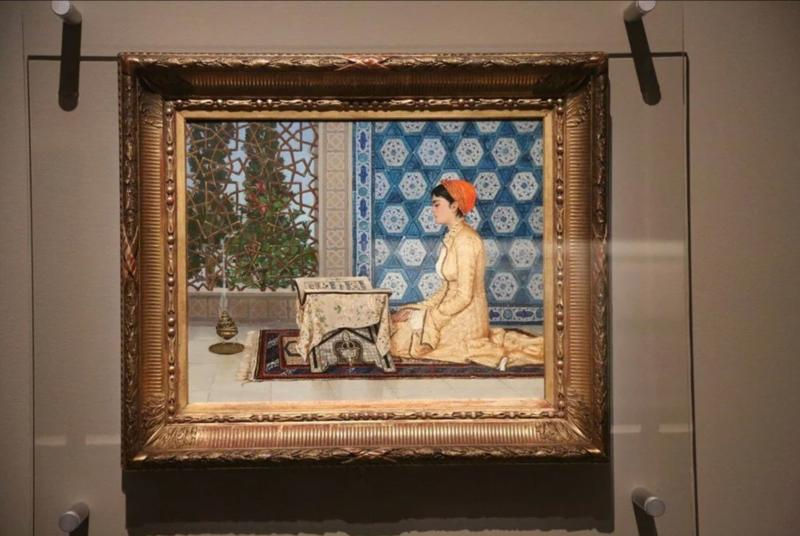
It was the gallerists, Baraz argues, who created this market. "Perhaps many people won't accept this, but it was through the galleries that Turkish painting gained value. We opened exhibitions to show that these works mattered. We set prices. We tried to explain that art was an asset, like shares in a company."
The commercial success, he acknowledges, came with its own shadow: works that had once been too worthless to bother stealing became, in time, worth stealing very carefully indeed.
Baraz, who entered the Academy of Fine Arts in 1964, puts it starkly: "In the 1960s, Beyazıt and Beyoğlu Tünel were full of second-hand dealers. The most valuable paintings in Turkey were being sold in those shops, sometimes lying on the floor. It was dramatic, the situation Turkish art had come to. There was no oversight at all. You couldn't even really call it theft, because the things had no monetary value. Nobody thought of it as theft."
They do now. Whether that is enough to protect what remains is a question the museum on Namazgâh Hill is still waiting to have answered.
(This news story was produced with financial support from the European Union and was first published on Independent Turkish on January 26, 2024. The content of this news story is entirely the responsibility of Fatma Gökçen Tuncer and the Journalists' Association and does not necessarily reflect the views of the European Union.)
Yorumlar