History beneath the brothels: Ankara's ancient layers resurface
Where Turkey's first state-licensed brothels once stood, archaeologists have unearthed an Ottoman bathhouse, a Roman theatre and a cache of medieval medallions — revealing a capital city far older, and far richer, than its grey modern reputation suggests.
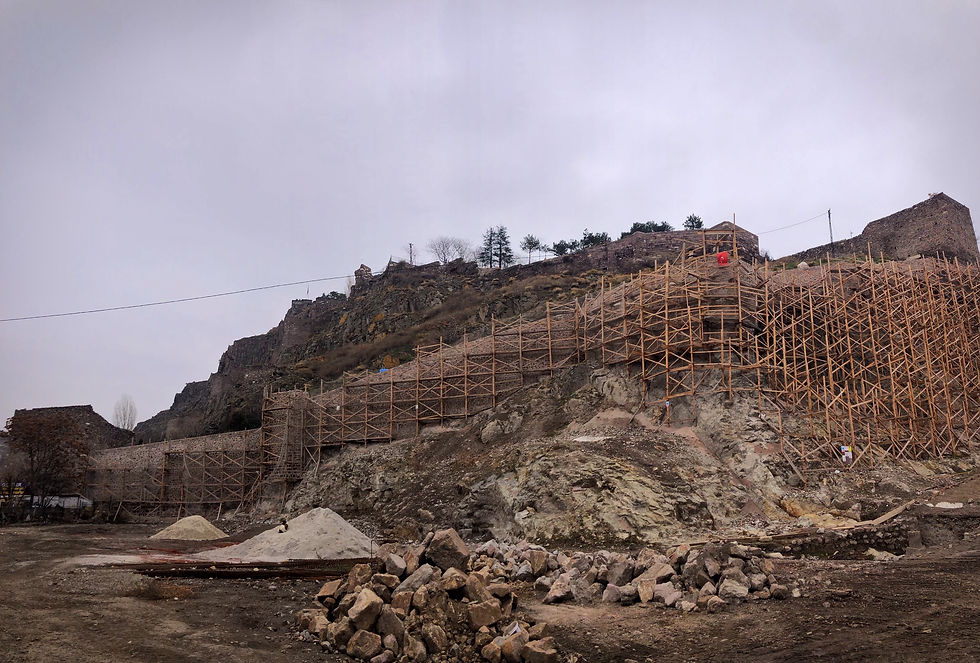
Bentderesi is a neighbourhood that has carried the weight of history on its narrow shoulders for millennia — Hittite traders, Roman legions, Ottoman tanners, and, for much of the twentieth century, the women who worked in Turkey's first state-licensed brothels.
Now it is carrying something else: the tools of archaeologists who are rewriting what Ankara's oldest quarter actually hides beneath its earth.
Nestled at the foot of Ankara Castle, Bentderesi served for centuries as a commercial and leisure hub.
By the 1930s, the Turkish state had established its first officially licensed brothels here, an arrangement that persisted for decades and gave the district a reputation that outlasted the buildings themselves.
Even after the brothels were demolished in 2010–11 — in circumstances that were, by most accounts, deeply contentious — the area remained largely avoided, used by the homeless and, for years, by drug users who sheltered in the ruins of the old Roman theatre.
That theatre, it turns out, was only the beginning.

A Dome Where No Dome Was Expected
In 2021, the Ankara Metropolitan Municipality and the Museum of Anatolian Civilisations launched an environmental conservation project around the Roman Theatre, which had been known to scholars since the 1980s. As part of routine excavation and protective work, archaeologists began drilling survey boreholes to determine what, if anything, lay beneath the soil.
Doğukan Yaycı, an art historian and archaeologist who has been involved in the excavations from the start, recalled the moment of discovery.
The team had been working in an area once occupied by the yellow-painted houses that stood over the former brothel district — structures demolished more than a decade earlier whose foundations nobody had looked beneath. "We were digging," he told Independent Türkçe, "and then suddenly a bathhouse dome appeared."

What followed was months of archival research. Yaycı and his colleagues combed through Ottoman and Arabic-language endowment documents — known as vakfiyes — held by the General Directorate of Foundations. The eminent historian Halil İnalcık confirmed the existence of a bathhouse on the site, one whose foundation records stretch back to the fifteenth century, the reign of Sultan Mehmed II, the conqueror of Constantinople.
The structure is now believed to be the Debbağhane Hammam — sometimes called the Tabakhane Hammam — dating to somewhere between the thirteenth and fifteenth centuries.
Its name points to its second life: after it ceased functioning as a bath, the site became a tannery and ceramics workshop. Excavators found pithos jars used to wash and cure hides, alongside hundreds of decorated pipe fragments and nearly four hundred coins.
Almost sixteen hundred ornamental tobacco pipes, in total, have been recovered from the site — and their presence tells its own story.

The Pipes of the Janissaries
"We tend to find pipes in great numbers at bathhouse and castle excavations," Yaycı explained.
The reason lies in Ottoman military culture. Hammams at the base of castle walls were typically operated by Janissaries — the elite infantry corps of the Ottoman Empire — who garrisoned the fortifications above.
The soldiers rested, bathed and smoked in these establishments, and the ceramic workshops on site produced the pipes they used. The coincidence of hammam, workshop and pipe, Yaycı noted, is practically a fingerprint of Janissary presence.

The find also resolves a long-standing administrative puzzle. The site sits precisely where the castle's slopes meet the lower city — exactly where such an installation would have been placed to serve the garrison above.
The Medallion and the Cappadocian Saint
Among the most intriguing finds are two medallions — one fashioned from a copper-bronze alloy, the other from mother-of-pearl — each roughly one and a half times the diameter of a one-lira coin.
Their discovery, and the months of painstaking research that followed, has opened an unexpected window onto Ankara's plural religious past.
The mother-of-pearl medallion bears what appears to be an image of the infant Jesus. The copper one proved considerably more challenging. Its surface was heavily corroded, and its inscription resisted easy reading for nearly a month. Yaycı, who holds expertise in Arabic, Persian, Ottoman Turkish and Ancient Greek, worked through the corrosion layer by layer.
"There was no parallel publication anywhere," he said. "At first I wasn't even sure it was a medallion rather than a coin. After cleaning, a saint's portrait became visible — but not one we recognised from the standard iconographic canon of Christianity."
The only legible word on one side was "Hiero." A saint's designation — St., or Saint — would normally precede such a name. More cleaning confirmed it: Saint Hieron.

A search through English-language scholarship eventually located him in a study of Cappadocia's regional saints. Yaycı himself had previously worked in Cappadocia, and when he opened his own archive photographs from that region, the face on the medallion matched a depiction of Hieron he had photographed in a church there.
According to a 2019 master's thesis on Christian heritage sites in Nevşehir province, Saint Hieron was a soldier-saint born in Göreme — a settlement whose ancient name, Maççan, is believed to derive from the name of Hieron's own mother.
He was martyred alongside thirty companions during the Persian wars, and his severed hand was reportedly kept for centuries at the Tokalı Church in Göreme.
The saint is associated with the Orthodox Christian tradition, and the area around Ankara Castle was historically home to a significant Armenian community.

The Roman Theatre behind the hammam site, Yaycı noted, stands at the edge of what was once an Armenian neighbourhood. "We are discussing among ourselves," he said, "whether the saint on our medallion is an Armenian and Orthodox figure. If so, the medallion is evidence that Armenians, Jews and Muslims lived side by side here."
A similar medallion has since been identified in a Spanish academic publication, though Yaycı says the Ankara example is notably better preserved.
From fake archeopark to real one
Before the hammam came to light, municipal planners had intended to create what Yaycı diplomatically called an "artificial archeopark" in the area — a heritage-themed space populated with replica artefacts.
The discovery changed everything. The municipality reversed course: the park would now display the actual finds, in situ, with no reproductions.
When complete, the planned open-air museum will encompass seventeen thousand square metres. It will include exhibition spaces dedicated to Ankara's archaeological strata, workshops for young visitors, thematic displays on the city's history, and virtual-reality experiences of its historic structures — all built around real excavation sites and genuine objects.
The theatre that chance uncovered
The Roman Theatre itself has its own origin story, equally accidental.
In 1982, construction began on a shoemakers' cooperative building on the site. During foundation work, historic artefacts began appearing in the soil. Construction halted; the Museum of Anatolian Civilisations was alerted; archaeologists from Ankara University's Department of Classical Archaeology took over. Excavations began — and then stalled. The theatre's position on a hillside meant vast amounts of earth had to be shifted with nowhere obvious to put it.

For decades, the site drifted into neglect. After the brothels were torn down in 2010–11, the ruins became a refuge for the homeless. Residents dumped rubbish in the ancient cavea. Drug users occupied it.
Even after the municipality's 2019 push to accelerate the work, Yaycı recalls that excavators sometimes arrived to find people still sheltering in the theatre, requiring considerable effort to relocate them.
Of an original capacity estimated at five thousand spectators, only the portion holding about 1,700 could be saved. Conservation work on the cavea resumed in 2021 under the municipality's Archeopark Environmental Arrangements project.

A city hiding in plain sight
Ankara's ancient depth is, for many of its own residents, a surprise.
The city is widely dismissed — by Turks and outsiders alike — as a grey administrative capital, a planned city without soul or history, the bureaucratic antithesis of Istanbul. The archaeologists working at its feet tell a different story.
The site at Bentderesi sits on the Royal Road — the great Achaemenid highway running from Ephesus to Persia, documented from the fifth century BC — and Ankara has been continuously settled since prehistory.
The city's wider catchment has yielded Hittite reliefs at Gavurkale in Haymana, discovered under orders from Atatürk himself in 1930, and a five-thousand-year occupation sequence at Külhöyük in Gölbaşı, a Hittite settlement that also sat on the ancient road network linking Anatolia to Mesopotamia and Syria.

The Phrygians, too, left their mark: ancient sources credit King Midas with founding Ankara, and the Phrygian capital Gordion lies within modern Polatlı district.
After the Phrygians came the Lydians, then the Persians, then Alexander's Macedonians, then the Galatians — that distinctive Celtic people who crossed from the Balkans and whose legacy survives in the very name Galatia.
Besides the traces of the nomadic and warlike Galatians in Istanbul, it is known that Galatia was established in the region encompassing Ankara, Eskişehir, and Yozgat.
After Roman Emperor Augustus brought Galatia under Roman rule in 25 BC, Ankyra became the capital of the Roman province of Galatia. During this period, the region became both an important military base and, for the first time in history, Anatolia was governed from Ankara.
Roman traces in the center of Ankara
Starting from the Hellenistic period, Ankara became a major Roman city. Today, this can be seen in the Roman baths, Roman theater, Temple of Augustus, and Roman ruins in the castle in the center of Ankara.
After the division of the Roman Empire into two, the city remained within the borders of the Eastern Roman Empire and maintained its military and logistical importance during the Byzantine period.
Ankara's strongest heritage: The Ahi brotherhood
Although the mass settlement of Turks in Anatolia began after the Battle of Manzikert in 1071, the Seljuks were only able to conquer Ankara in 1073.
Following the Mongol invasion of Anatolia, the city came under the rule of the Ilkhanids in the early 14th century. Before passing to the Ottomans, it was governed for a time by the Ahi Brotherhood with a local form of administration.

Ahi brotherhood, in its most general definition, is the name given to the guilds of craftsmen, artisans, and producers adhering to the principles of Islamic Sufi thought, and the moral, political, economic, and philosophical feelings and principles practiced by these guilds.
According to historian Ahmet Refik Altınay's definition, the Ahi brotherhood, while not forming a government, were influential figures in places where there was no ruler.
“After the fall of the Seljuks, during the period of chaos in Anatolia, everyone surrendered to a different place. But in Ankara, the Ahi brotherhood governed the city with a democratic system, similar to today's democratic governance model. Later, they integrated with the Ottoman Empire of their own free will, without war”, Ödemiş said.

The Ahis, a guild-based fraternal order whose democratic instincts, Ödemiş noted, were part of what drew Mustafa Kemal Atatürk to choose the city as the seat of the new republic, recalling his words, "I learned about Ankara not from geography books, but from history, and I learned about it as the center of the Republic. Ankara is not just a province, a region, or a capital city. Ankara and its people hold a very special place in my heart”.
The capital of the new republic
Following the Balkan Wars and World War I, Mustafa Kemal and the Representative Committee of the Society for the Defense of Rights, finding it dangerous for the Ottoman State, which had lost power, to remain centered in Istanbul, came to Ankara on December 27, 1919, and announced to all deputies via a communiqué that the meeting would be held in Ankara.
Ankara, which became the center from which the War of Independence was directed, was declared the government center after the establishment of the Grand National Assembly of Turkey on April 23, 1920.
With the law enacted on October 13, 1923, Ankara officially became the new capital of the new Türkiye.
(Update in 2026) : The wider recognition is coming
In 2023, two of Ankara's historic assets were inscribed on the UNESCO World Heritage List: Gordion Ancient City, the Phrygian capital whose ruins lie within the city's modern borders, and the Arslanhane Mosque — also known as the Ahi Şerafettin Mosque — as part of the transnational nomination "Medieval Anatolian Timber Hypostyle Mosques."
Then, in 2025, Ankara itself was added to UNESCO's World Heritage Tentative List, under the designation "Planning and Construction of a Modern Republican Capital" — an acknowledgement not only of its ancient foundations but of the audacious act of will that conjured a capital from a provincial Anatolian town just over a century ago.
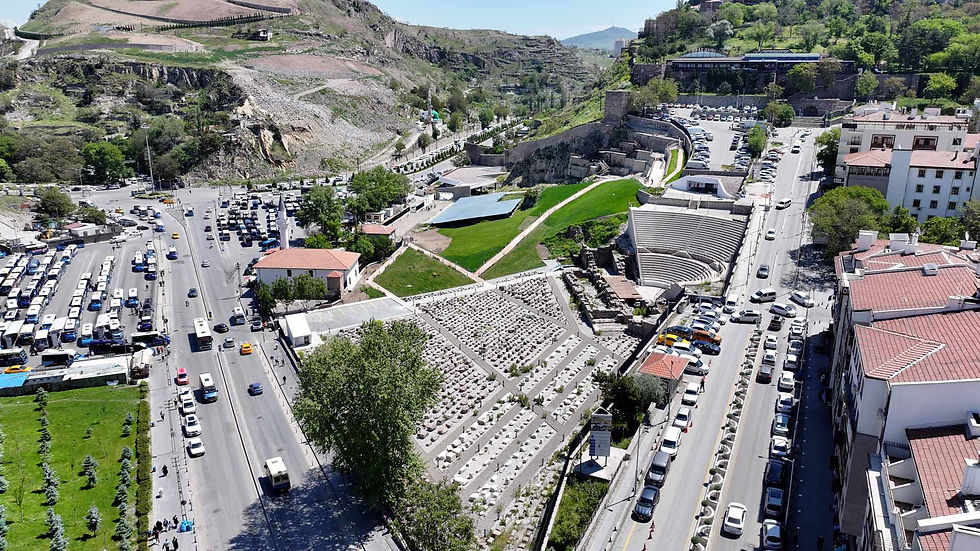
Lastly, the restoration of the Roman theatre and Archeopark, which began in 2021, was completed in the summer of 2025.
A city that gave the world the Royal Road and the Phrygian throne, that housed Janissaries and Armenian craftsmen and Ottoman tanners within the same hillside, that sheltered the independence movement of a collapsing empire and became, against most expectations, the beating heart of a modern republic — Ankara, it turns out, has always had more to say than its grey reputation allowed. The archaeologists working at its feet are only the latest to listen.
(This article was first published in Independent Turkish on January 24, 2023)

Yorumlar