From Mauritania to Harran: A family’s quest to preserve a hidden heritage
Nestled in the sunbaked plains of Şanlıurfa province, the town of Harran is a region that is as valuable as Göbeklitepe. While archaeologists have excavated its underground treasures for seven decades, Harran’s above-ground jewels — its iconic beehive-shaped “kümbet” houses — remain largely in the background. For the Özyavuz family, protecting these structures has been a lifelong mission.
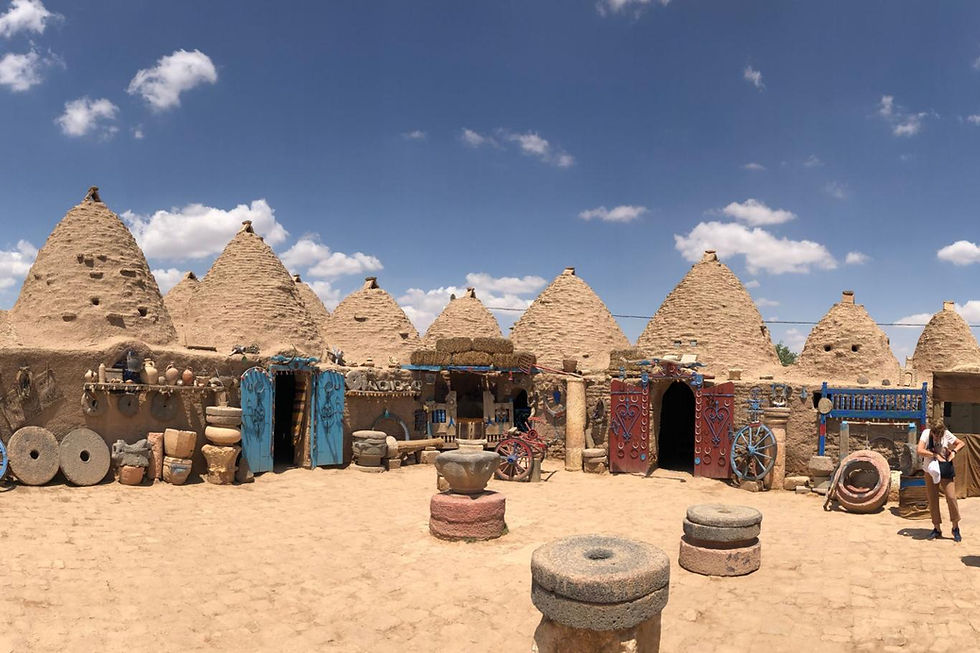
“People talk about this place as if it were Texas, where everyone walks around with guns on their hips,” says Ahmet Özyavuz, gesturing to the ochre-hued town.
He is talking about the place where the Prophet Abraham is said to have lived; the ancient capital of the Assyrian Empire; the seat of a mysterious moon god called Sin; a crossroads city that sheltered Babylonians, Persians, Hittites, Byzantines, and Seljuks, and that today sits on UNESCO's Tentative World Heritage List. He is talking about his hometown.
Harran lies at the southern tip of Turkey's Şanlıurfa province, a stone's throw from the Syrian border. Its ruins rise from a plain so flat and sun-baked that the horizon seems to shimmer.
Its most arresting feature is neither the crumbling Ulu Mosque — the oldest surviving mosque built in the Islamic architectural tradition — nor the remnants of what historians call the world's first university. It is the houses: dozens of conical mud-brick towers clustered together like a field of beehives, their silhouettes unchanged for millennia. For most of his 36 years, Özyavuz has been trying to save them.
Tourism in Harran is a family business, and the Özyavuz family have been at it longer than almost anyone.

When British archaeologists launched the first formal excavations at the Harran Mound in the 1950s, Ahmet's grandfather was working on site as a clerk.
His father, Halil Özyavuz — a retired official from the Ministry of Culture and Tourism — converted the family's historic beehive home into a cultural guesthouse in 1989, the building in which all fourteen of his children were born. Since then, the family has been using that house to introduce visitors to Harran's customs, its food, and its way of life.
"I have this obsession with Harran," Ahmet says. "Every time I look at it, I feel I have to add something to it."
After finishing secondary school in 2005, he enrolled in a tourism course in Cappadocia, the volcanic landscape of central Anatolia whose cave hotels had by then become a global phenomenon.
He spent a year there doing internships at different properties, but his mind never left the south. "Even at that age, I went to Cappadocia thinking: how do we transform Harran? How do we bring more visitors?"
He came back with a clear ambition: build a hotel in Harran.
The wars that stole the tourists
It was a brave dream, perhaps a naïve one. Harran's tourism had been throttled for years by a cascade of geopolitical misfortunes that had nothing to do with the town itself.
In the 1990s, the region was tarnished by association with the PKK insurgency raging in southeastern Turkey — unfairly, Özyavuz insists.

"Not a whisper of terrorism came through Harran. We are a deeply nationalist district. The clans here would never have allowed an enemy of Turkey to shelter among them." But the perception stuck, and tourist numbers collapsed.
Just as that stigma was fading, the United States invaded Iraq in 2003. The ripple effects reached Harran within months. "In the early 2000s, foreign tourists were flooding in" Özyavuz recalls. "Then America went into Iraq, and it was over. Completely finished."
The execution of Saddam Hussein in 2006 did little to restore calm. It was not until late 2007, when an international tourism initiative revived the ancient "Abraham Path" trail connecting sites across the Middle East, that the first green shoots of recovery appeared.
At that time, Ahmet Özyavuz, motivated by the thought, "If I'm involved in tourism, I need to build a hotel here," wanted to join these efforts.
However, he faced another obstacle: bureaucracy.
Mauritania, Rwanda, and a carpet
Applications to the Ministry of Culture and Tourism, to heritage bodies, to the municipality — all were met with silence or polite deflection. No institution, he says, was willing to help him build what he envisioned. Eventually, wounded, he left.
"I sulked my way to Gaziantep and enrolled in university," he says.
In his final year of study, a professor made an unexpected suggestion: a machine-carpet exporting firm was looking for someone with English and Arabic. Özyavuz had both. He applied, somewhat apologetically. "I told them: I'm a tourism person. I know nothing about carpets or trade." They told him they would train him. Two months of internship later, he was sold.

What followed was a five-year education in the world. First came Mauritania — a country of horse-drawn carts, open desert, and a near-total absence of the infrastructure Özyavuz had taken for granted growing up on the fertile Harran plain.
Then Rwanda, still carrying the raw grief of its genocide but possessed of a staggering natural beauty. His successes there opened doors to Abu Dhabi, Kuwait, Egypt, Lebanon, and finally Germany.
"I was seeing the world, travelling constantly, earning decent money," he says. "But money was always secondary for me."
The return
In 2016, his father called him back home. Halil Özyavuz was approaching seventy. The work at the cultural house needed a younger pair of hands. Ahmet came home.
He found a Harran that had once again been knocked sideways — this time by the Syrian civil war, which had begun in 2011 and had rattled the entire border region. But it was also, tentatively, recovering. The surge in global interest around Göbeklitepe, the 12,000-year-old temple complex thirty kilometres to the north, was drawing crowds to Şanlıurfa, and a significant portion of them were continuing south to Harran.
His first act on returning was to found an association: the Association for the Protection, Promotion, Preservation, and Tourism Development of Harran Houses. He gathered around him everyone he could find who had left for education and come back — students, teachers, academics, tour guides, historians.
The association had ambitions that were, in retrospect, modest: volunteer to replaster the beehive houses, secure outside funding, bring in architects and interior designers to modernise the interiors while preserving the iconic exteriors.

"If you want to live in a kümbet," Özyavuz says, using the Turkish word for the conical structures, "the outside must stay authentic. But the inside can be made comfortable. A foreign visitor should be able to sleep there."
He knocked on every door. The response, door after door, was a variant of the same phrase: "What's the point?"
"Şanlıurfa has fourteen members of parliament, spread across four parties," he says, his frustration controlled but audible. "If each of them had done one thing for tourism in Harran — one cultural house, one hotel, one restoration project — we would have fourteen new attractions. But everyone is just thinking: 'let my own garden be watered.'"
The association slowly collapsed, its members' enthusiasm ground down by indifference. Özyavuz eventually dissolved it.
Many of those who go to Göbeklitepe also visit Harran
Even though the association has closed, the efforts of the Özyavuz family continue.
After visiting the Great Mosque, built during the Umayyad period and holding the title of the oldest mosque built in Islamic architecture, and the ruins of the world's first university, one of the most important places you will see in Harran is the dome houses.

The Özyavuz family is one of the few families trying to preserve these houses, made of earth, which are warm in winter and cool in summer, in their original form.
According to the data of the Ministry of Culture and Tourism, before the pandemic, in 2019, the "Year of Göbeklitepe," the number of tourists visiting Şanlıurfa was over 1 million. 60 to 70 percent of these tourists also see Harran. The target for 2022 and beyond is 2 million.
The city that taught the world to count the stars
According the book "Archaeology of Harran and its Surroundings" published by the Şanlıurfa Culture, Education, Art and Research Foundation, the name Harran first appears as "Haranki" in the Ebla tablets dating back to 2400 BC. This word means "road, path, trail, travel, journey, caravan" in Assyrian.
And these meanings are not accidental. For millennia, Harran was all of those things at once: the hinge point between Anatolia and Mesopotamia, the obligatory rest stop on the great overland routes that carried tin, textiles, and grain between civilisations that barely knew each other's names. To pass between the two worlds, you passed through Harran. There was no alternative.

The city's intellectual life was inseparable from its religion. Harran was one of the principal centres of ancient Mesopotamian paganism — a belief system in which the moon, the sun, and the planets were not metaphors for divine power but were divine power, present and observable in the sky above.
The moon god Sin was the supreme deity here, and his temple, which archaeologists have partially uncovered amid the city's ruins, was among the most important sacred sites in the ancient Near East.
The theological consequence of worshipping the sky was, over centuries, something unexpected and productive: a rigorous science of observing it.
Harran's astronomers were not merely priests performing ritual; they were, by the standards of their age, empiricists — people who watched, recorded, and calculated. The Temple of Sin was also, in a meaningful sense, an observatory.
That tradition persisted long after the old religion had given way to Islam.
Harran's university — one of the ancient world's earliest institutions of organised higher learning — continued to attract and produce scholars of remarkable range.
Among the famous scientists who grew up in Harran were Thabit ibn Qurra, one of the greatest mathematicians and physicians of his time, who translated the works of Greek philosophers into Arabic; Al-Battani, the astronomer who accurately calculated the distance from the Earth to the Moon; Jabir ibn Hayyan, considered the inventor of the atom and algebra; and the renowned religious scholar Sheikh al-Islam Ibn Taymiyyah.
The end of the glory: Mongol invasion
After the Assyrian Empire, which ruled from the 2000s BC to the 7th century BC, Harran came under Babylonian and Persian rule, and the Islamic period began from the 600s AD.

The region was successively ruled by the Umayyads, Abbasids, Handanids, Sayids, Seljuks, Zengids, and Ayyubids. Following the Mongol invasion in 1260, Harran never regained its former glory.
Harran, which became part of the Ottoman Empire in 1516, was a district of Akçakale during the Republic period. It became a district in 1987. But the great university was gone. The temple was rubble. The caravans no longer needed to stop here; other routes had opened, other cities had grown.
What survived was the landscape and, more remarkably, the architecture.
The vanishing houses
When Turkish authorities formally designated Harran an Archaeological and Urban Conservation Area in 1979, surveyors counted 960 conical beehive houses — the extraordinary mud-brick structures, known locally as kümbets, that have been the settlement's most distinctive feature since at least 2000 BC.
The number of these houses, which were included in the UNESCO World Heritage Tentative List in 2000, later dropped below 100.
According to Ahmet Özyavuz, a native of Harran who has been involved in tourism for years, there were approximately 2600 domed tombs 20 years ago. Today, only 250-300 domed tombs remain.
The discrepancy between the official figure and the local count reflects, in part, what is being measured: some structures survive as barns, grain stores, or roofless shells, their original function long gone. What is not disputed is the direction of change. The kümbets are disappearing. Many have simply collapsed from lack of maintenance — the exterior mud plaster that protects them from rain must be renewed every three to four years; without it, a single wet season can undo centuries of survival. Others were demolished by residents who replaced them with concrete blocks, cheaper to build and easier to live in, even though the site's conservation status formally prohibits such alterations.

The architecture of survival
The beehive houses are more technically sophisticated than they appear. From the outside they seem circular, but the base is in fact square.
Mud bricks are laid across the corners in a gradually rotating diagonal pattern, climbing upwards until the square becomes a cone.
A single kümbet — the word refers to the whole structure, not just the roof — requires between 1,800 and 2,000 bricks and constitutes a single room. Extended families link multiple kümbets together in L- or U-shaped clusters around a shared courtyard, the whole compound serving as a world unto itself.
The absence of timber in the region drove the design. With no wood for conventional roof beams, builders engineered a solution using only earth and stone — one that happens to be extraordinarily well-suited to the climate. The thick walls absorb heat during the day and release it at night; in summer the interior temperature can be ten to fifteen degrees cooler than the air outside. A hole left in the apex of each cone serves as both skylight and natural ventilator.
Maintenance, however, is relentless. The exterior plaster must be stripped and reapplied every three or four years as sun and rain degrade the mud. The interior requires attention every 10 to 13 years. "You can't plaster over old plaster," Özyavuz explains. "It will fall off. You have to scrape back to bare earth, bring fresh soil, sieve it, and start again."
To do any of this legally requires a permit from the Ministry of Culture and Tourism. Permit applications must be submitted with photographs and a material specification. An inspector visits. An approval — or a rejection — arrives, on average, three months later. "A letter that could travel from Urfa to Harran in an afternoon takes three months to arrive," Özyavuz says.
In practice, many residents don't wait. The consequence is predictable: prosecution. By Özyavuz's estimate, ninety per cent of Harran's residents have at some point faced legal action related to their homes. His own father received a criminal sentence — later converted to a fine — after part of their courtyard wall collapsed in a rainstorm. They had not knocked it down; rain had. "It's designated heritage," Özyavuz says. "But if a wall falls on its own, you're responsible."
The Italian comparison
The analogy Özyavuz returns to repeatedly is Alberobello, a small town in the Puglia region of southern Italy whose trulli houses — conical stone structures strikingly similar to Harran's kümbets — were added to UNESCO's World Heritage List in 1995. Alberobello became a sister city of Harran in 2013.

The trulli of Alberobello are now among the most photographed buildings in Europe. Their owners are supported by a Property Management Plan that protects the structures while enabling residents to generate income from them as guesthouses, shops, and restaurants. The architecture is preserved; the community benefits; the tourists come.
"If the Ministry would help us," Özyavuz says, "we could tell landowners: even if you don't want to open to tourism, build yourself a kümbet to live in. Keep the outside original. Modernise the inside. That's all we're asking."
His own family lives not in a kümbet but in a concrete apartment block in the newer part of Harran. He once asked the mayor and the district governor for a plot of land on which to build a traditional home for himself and his relatives to live in. "They said no," he recalls, without apparent surprise.
What remains
The Özyavuz cultural house is still open.
Visitors who find their way there discover a labyrinth of interconnected conical rooms: a traditional kitchen, a sitting room furnished with embroidered cushions, long tables set for tea. They are met by members of the family in regional dress and, usually, by Ahmet himself — voluble, funny, visibly proud, and visibly tired.
The economics are punishing. Monthly electricity and water bills alone run to at least 2,000 lira. There are no government subsidies, no institutional grants. Nephews and other relatives pitch in; without them, Özyavuz says, the operation would be impossible to sustain. During the pandemic, when planes stopped flying and tourists vanished, he kept himself afloat by helping a friend irrigate his fields.

"If we weren't here as a family, this place probably couldn't survive," he says. He pauses. "Most of the support goes to the archaeological digs. The stuff underground. The stuff above ground — nobody cares."
Outside, the afternoon light turns the remaining kümbets the colour of old honey. In the distance, the ruins of the Assyrian moon temple are a smear of ancient stone against a cobalt sky. The history here is staggering; the silence, in its way, is too.
Ahmet Özyavuz locks up the cultural house and looks at the street. A few tourists are filing back toward the car park. A kümbet two doors down has developed a crack along its eastern face. Nobody will fix it tonight. Nobody has applied for a permit. Nobody is sure who is responsible. In Harran, this is how walls learn to fall.
(This article was first published in Independent Turkish on July 8, 2022)

SPLENDİD...