The story of those who walk through fire to live
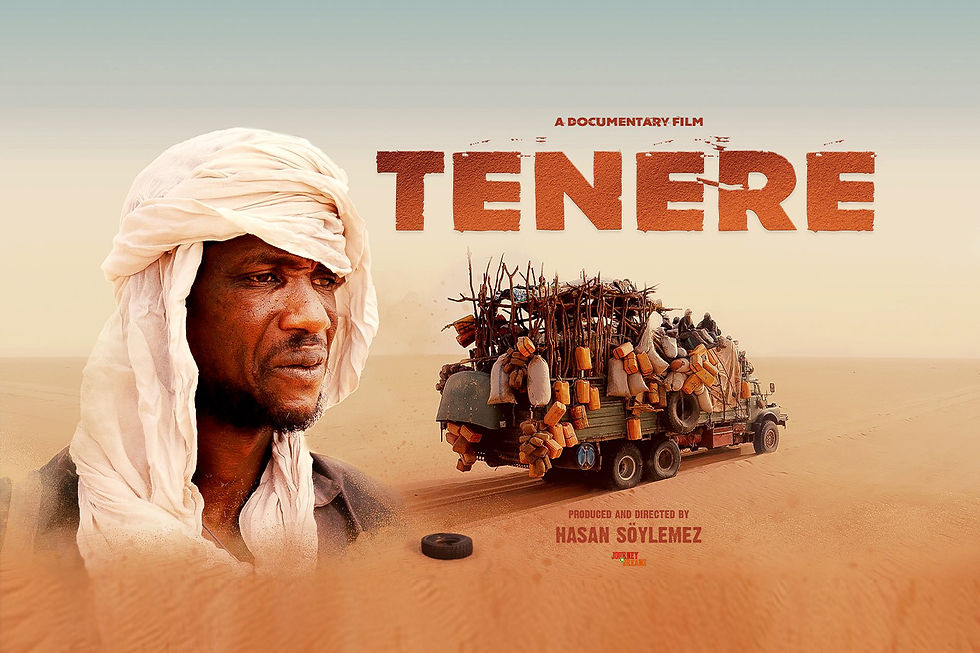
Journalist and documentary filmmaker Hasan Söylemez paused his bicycle journey across all 54 African nations to make his first feature-length film. Tenere tells the story of those who must cross the Desert of Deserts just to survive.
20 October 2011.
The world watches the end of a 42-year reign through a mobile phone camera.
The final images of the longest-serving leader in the Arab and African world enter history while his face is covered in blood, his lifeless, wound-riddled body displayed in a cold-storage facility.
After the era of Muammar Gaddafi — self-proclaimed "King of Kings of Africa" — draws to a close, the global media turns its lens to a civil war fuelled by a two-headed power struggle within Libya.
Four years later. Niger.
Amadou Bashir grew up in a family of twelve children. He once dreamed of becoming a journalist — "because journalists are the ones who know people's lives best," he would explain. Instead, he trades goods for a living. And to do so, he must cross a desert.
To support the wife and four children who survived after two others died, Bashir must travel hundreds of kilometres through the desert.

One day, during the fighting in Libya, he was shot. He spent 21 days in hospital. He never knew who pulled the trigger. And the world did not know that a civil war ignited by the fall of a dictatorship could reach into the life of a poor man in Niger — until someone from Turkey turned a camera on Bashir.
The Dream Hunter's dream
Hasan Söylemez.
The journalist and documentary filmmaker who, after cycling across Turkey in 2010, set off again in January 2017 — this time to fulfill his greatest dream: Africa. In nearly three years he completed West Africa; he aims, in an open-ended timeline, to reach all 54 African nations.
Wherever he goes, he puts people in front of his camera and asks a single question: "What is your dream?". He is the Dream Hunter.
It is possible to follow every pedal of Hasan's journey through his YouTube documentary series Journey to Dreams. What brought him from Africa's red earth to Istanbul's Zorlu Performing Arts Centre was his first feature-length film: Tenere.

Tenere is the story of those who cross 800 kilometres of desert and nothingness — facing death by thirst, banditry and disorientation — in order to earn enough money to sustain their families for six months or a year.
From the desert to an 800-seat auditorium
Hasan spent ten of the roughly thirty days of shooting in the desert itself.
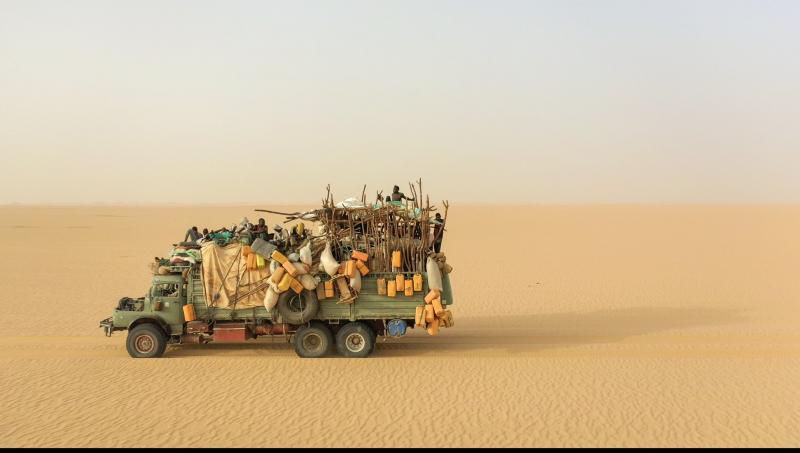
Sometimes in the open back of a worn-out truck with no bonnet cover, crammed alongside nearly twenty people and dozens of sheep. Sometimes in the pickup trucks of the soldiers escorting the convoy. Forty-five degrees of heat. Limited water. Ten days.
After two weeks of translation work in Niamey, Niger's capital, and two and a half months of editing in Istanbul, Tenere — destined to compete at international festivals — had its Turkish premiere on 2 November 2019. True to his word on Twitter, Hasan was there at the door, personally greeting every single person who arrived.
Once the audience settled and Hasan welcomeed them in an excited voice, 93 minutes began — the story of a man whose road happened to cross the road of those who had no choice but to have one.
"More people die in the desert than at sea"
The first scene begins and the color of yellow that passes through the drone frame and pins you to your seat. Then the other colours, vivid enough to strike you more. And then the first line: On this journey, what we wonder is whether we will arrive at all.
Tenere — meaning "Desert of Deserts" in the Tuareg language — is a region of 400,000 square kilometres within the Sahara. The two nearest trees are 400 kilometres apart. Two water wells, 200 kilometres.

Those who set off on top of a truck from Agadez, the city at the heart of Niger, are heading for different destinations: sometimes Dirkou, 800 kilometres away; sometimes Libya — if they can survive the Chadian and Tuareg bandits; sometimes Zuwara, Libya's gateway to the Mediterranean, and from there, clandestinely, Europe.
In other words, the journalists photographing migrants in rescue boats or washing up lifeless on shores are covering the final stop of a migration route. Hasan Söylemez's camera was at the place where it all begins.
"We always see people trying to cross the Mediterranean in dinghies," Hasan says. According to United Nations figures he cites, the number of people dying in the desert exceeds those dying at sea. More than 4,000 deaths were recorded in the desert between 2015 and 2019 alone, alongside more than 22,000 rescues between 2016 and 2019.
Gaddafi died, the Libya route closed
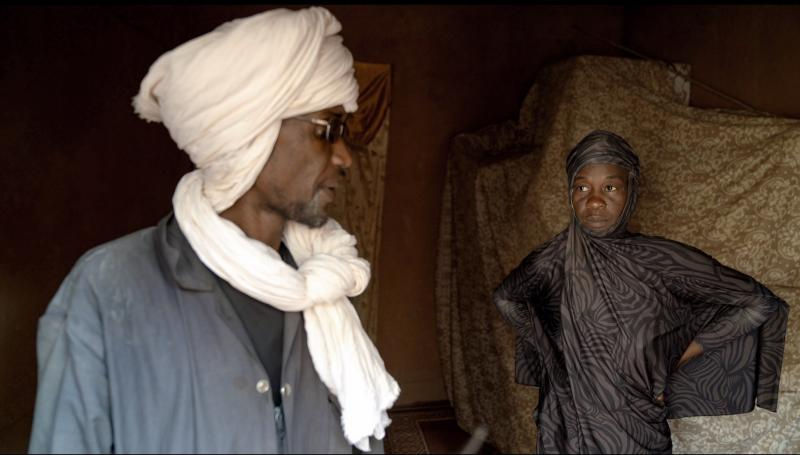
Amadou Bashir, whom Hasan follows throughout the film, has crossed the desert countless times. He is 47 now. He hasn't been to Libya — "the place everyone once dreamed of living," as he puts it — for a long time. The shooting was his turning point.
His wife of ten years — "our livelihood depends on him going" — says that he can go to any country except Libya. She recounts, eyes filling with tears, the fear she felt when he was shot.
"You cannot show your grief to anyone," she says, "because I am not the only one whose husband is far away. So I always keep it inside." She is saying this as she ties a protective amulet around Bashir's neck before he sets off again.
"Be patient," says Bashir. "I have no choice," says his wife.
And the journey towards Dirkou — the trading post called "the port of the Sahara," where Libyan goods are sold — begins.
The place where a person, a sheep and a tyre are equal
Have you ever been ashamed of details?
While we complain that our three-bedroom apartments feel cramped, somewhere in the world people crossing a desert in the back of a narrow truck are building a wooden cage inside it — so the animals travelling with them won't be disturbed.
While we grumble about the milk in our coffee not being the right kind, we share a planet with a country where 25 litres of water is considered wealth.
While we blind ourselves with our ambitions and shut out everything unlike us — how aware are we of distant countries where a living person, a dead sheep, and a truck tyre have equal chances of making it?
Hasan's curiosity began in 2017 with a photograph he saw online and the thought: I have to be part of this journey. Years later it became Tenere. And because of it, we learnt about lives we shared a planet with but knew nothing of.
Two days in the desert and finding the water
While speaking with Hasan after the screening, I told him: somewhere along the way, you changed the direction of time.
Let me explain what I meant with a moment he described both on Twitter and in the film itself.
The gathering point for many Africans heading across the Tenere to reach the Mediterranean is a tree and a water well — encountered after five days of desert travel out of Agadez. It is a rest stop in the middle of absolute nothing.
At that spot, a man appeared from nowhere after walking 17 kilometres, and he reached Hasan's convoy under that tree. He was asking for help. His vehicle had broken down. Twenty-five people — including children — had been stranded in the desert for two days. Their water was almost gone.
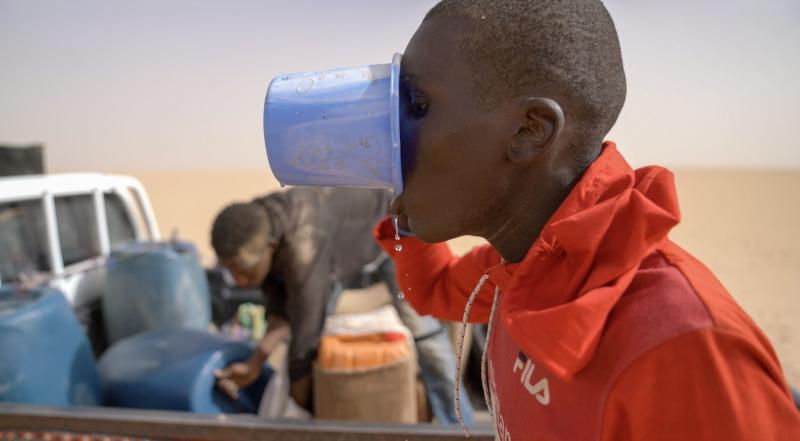
"In this desert, everyone is concerned only with their own survival," Hasan wrote on Twitter, describing what became one of the film's most arresting scenes:
"Nobody volunteered to help. It was only through my intense insistence that we went to rescue the 25 stranded people. Had we arrived much later, they would have died of thirst in the scorching heat. The moment they met water is something I will never forget as long as I live."
Mohammed: Smuggler or dream maker?
Tenere begins by following Bashir, but the human story it tells belongs to more than one person. Among them is Mohammed — whom everyone calls "Boss."
Mohammed is a people smuggler. "Yes, he is a smuggler," Hasan says, "but he has made the dreams of a great many people come true."
"If you are in a sub-Saharan country, my name will reach you somehow," Mohammed says in the film — adding that he has taken thousands across the desert over the years, some of whom have been living in Europe, even America, for many years now.
The " guarantor" of a route once crossed by slave caravans: €1.8 Billion
Tenere was not always a clandestine migration route. As Bashir explains to those around him during a tea break in the desert, caravans crossed this same path on camelback for centuries — a roughly 60-day journey to reach trading ports in Libya.
Irregular migration to Europe along this corridor was relatively limited until 2012, when it intensified after Gaddafi's fall.
In 2015, the European Union and African nations meeting in Valletta, Malta, signed an Emergency Trust Fund for Africa. Its full name: the Emergency Trust Fund for stability and addressing root causes of irregular migration and displaced persons in Africa. Its value: €1.8 billion.
Under the agreement, the fund was meant to support basic services such as health and education and to carry out "capacity-building activities" in migration and border management across 23 African countries, including Niger.
Hasan describes the outcome as "the construction of an invisible wall in the triangle of Niger, Libya and Algeria." A route that had until then been legal became, overnight, illegal.

Mohammed — who keeps his face hidden from Hasan's camera throughout — has his own understanding of how the meaning of "illegal" has shifted across the centuries: "Westerners took people from here as slaves hundreds of years ago and sold them in Europe. Now why don't they want them to cross to Europe?"
What is madness, really?
Tenere is a fragment of the greatest humanitarian drama of this century.
It is the starting point of the "migration crisis" — the part of which we only ever see as it reaches the boats on the sea.
It is a documentary about one person, one route, those compelled to set out on it, and the man who crossed paths with them.
When you leave a screening of Tenere, you might call Hasan mad. As a person who have been following him for years, I would not use that word. I would call him "the man who holds tightly onto the connection to the world that most of us have severed without even noticing."
Like Bashir — who does not hesitate to set out into the middle of nowhere and never misses the small pleasure of a glass of tea along the way.
It is Mohammed, unwittingly, who explains people like Hasan and Bashir to the camera looking back at him:
Tenere is the story of both the fire, and of those who walk upon it.
(This article was first published in Independent Turkish on November 19, 2019)

Yorumlar